Cattle Cabin

Why it's listed
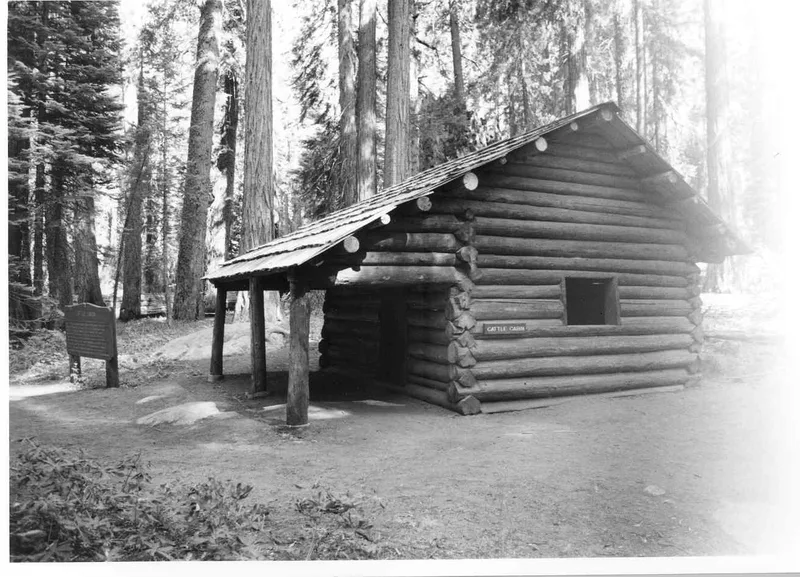
Cattle Cabin is a small log structure in the heart of the Giant Forest in Sequoia National Park. Measuring about 14 by 16 feet, it has a dirt floor, a shake roof on log beams, peeled logs joined with triangular notches, and a 7-foot porch on the north side. Around 1885 Hale Tharp, John Jordan and Ed Fudge built it after buying 830 acres at Circle Meadow to supplement summer cattle range. It served as storage for salt and supplies and as shelter in bad weather, and it was the first building in the area apart from Tharp's hollow-log shelter. Later, tour guides leasing the meadow used it as a slaughterhouse and storeroom, supplying beef and milk to tourists and army troops. The Department of the Interior bought the cabin and land in 1916 for $70,000 to protect the Big Trees. A restoration around 1966 replaced decayed logs and roof beams while keeping the original design. It is recognized for settlement, agriculture and conservation history.
Significance in brief: The nomination argues local significance in exploration/settlement, agriculture and conservation. It was the first building erected in the Giant Forest region apart from Tharp's hollow-log shelter, and it is a well-preserved late 19th century stockmen's camp. Its later use by tour guides, army troops and park rangers ties it to the conservation of the Big Trees.
Machine-generated summary. This summary was generated by a language model from the official nomination document and has not been reviewed line by line by an editor. It may contain errors. Check the source document before relying on any detail. Source: nomination document (PDF) · National Archives catalog entry. NRHP reference 77000150, listed September 15, 1977. Summary generated October 2026 (model claude-sonnet-5-5, prompt v1.0-2026-10-29, confidence medium).
Key facts
| Address | NE of Three Rivers on Sequoia National Park, Three Rivers |
|---|---|
| County | Tulare County |
| Listed | September 15, 1977 |
| Reference number | 77000150 |
| Resource type | Building |
| Period of significance | 1800-1899, 1900- |
| Architect / builder | Hale Tharp, John Jordan and Ed Fudge |
| Areas of significance | Agriculture, Entertainment/Recreation, Exploration/Settlement |
| Level of significance | Local |
| Status (as stated in the nomination) | Restored circa 1966 with replacement of decayed logs, roof beams and shakes; condition marked good, in public ownership and used as a museum. |
| Acreage | 0.9 |
| Coordinates | 36.57152, -118.75386 (NPS GIS) |
What listing means for this property
National Register listing is honorary for a privately owned home: it does not by itself restrict what an owner may do with their own money, and it does not require public access. Restrictions come from local landmark or historic-district ordinances, which are separate (how they differ).
Owner-occupied houses are not eligible for the 20% federal rehabilitation tax credit, which applies to income-producing buildings, but many states offer credits for homeowners. Listing also opens the door to preservation easements and to buying a plaque. Start with what listing means for homeowners, renovating a listed house and selling one.
General information, not legal or tax advice. Rules change; confirm with your State Historic Preservation Office or a qualified adviser.
Sources and further reading
- National Park Service, National Register of Historic Places database (snapshot May 2026), reference 77000150.
- Nomination form (PDF, National Archives) — catalog entry
- Wikipedia article (used for cross-checking only; text not reproduced here)
- Wikidata Q5054092
- This listing as JSON
Last updated October 2026. Found an error? See the editorial policy for how to report it.