Union Ferry Depot
Also known as: Ferry Building

Why it's listed
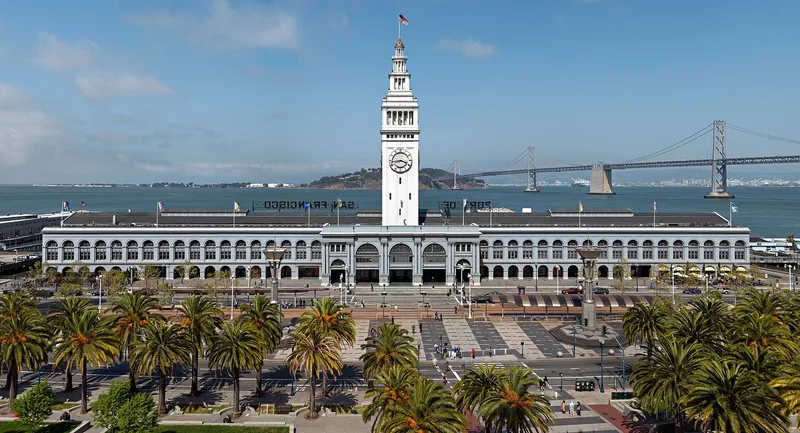
Rising 235 feet above the foot of Market Street, the Ferry Building is a steel-frame Beaux Arts terminal on San Francisco's Embarcadero. Construction began in 1895 and finished in 1903, following a design by architect A. Page Brown, who died soon after construction contracts were let. Edward R. Swain then served as supervising architect. The clock tower was modeled on the twelfth-century Giralda in Seville, and its clock faces were the largest in the United States when installed. The building also earned recognition for engineering: its reinforced-concrete foundation helped it survive the 1906 earthquake with little damage, and the American Society of Civil Engineers named it a Historic Civil Engineering Landmark in 1975. Before the Golden Gate and Bay Bridges opened, it handled some 50 million commuters a year, making it among the busiest passenger terminals in the world. Ferry service ended in 1956, and the interior was converted to offices, though the exterior remains largely as built.
Significance in brief: The nomination calls it an architectural, engineering and historical landmark. Its 235-foot clock tower was modeled on Seville's Giralda, and its reinforced-concrete foundation helped it withstand the 1906 earthquake. Until the Golden Gate and Bay Bridges opened, it served as a major commuter and mail terminal, handling about 50 million passengers a year.
Machine-generated summary. This summary was generated by a language model from the official nomination document and has not been reviewed line by line by an editor. It may contain errors. Check the source document before relying on any detail. Source: nomination document (PDF) · National Archives catalog entry. NRHP reference 78000760, listed December 1, 1978. Summary generated October 2026 (model claude-sonnet-5-5, prompt v1.0-2026-10-29, confidence high).
Key facts
| Address | Embarcadero at Market St., San Francisco |
|---|---|
| County | San Francisco |
| Listed | December 1, 1978 |
| Reference number | 78000760 |
| Resource type | Building |
| Period of significance | 1800-1899, 1900- (specific dates 1895-1903) |
| Architect / builder | A. Page Brown; Edward R. Swain |
| Architectural style | Neo-classic Beaux Arts |
| Areas of significance | Engineering, Transportation, Architecture |
| Level of significance | National |
| Status (as stated in the nomination) | Ferry service ended in 1956. The interior was altered into offices, used by the World Trade Center, commercial tenants and Port offices, while the exterior keeps its original appearance to a remarkable degree. |
| Acreage | 2.8 |
| Coordinates | 37.79548, -122.39320 (NPS GIS) |
What listing means for this property
For an income-producing building, listing (individually or as a contributing building in a district) is the gateway to the 20% federal rehabilitation tax credit on qualified rehabilitation costs, often stackable with state credits. Work claiming the credit must follow the Secretary of the Interior's Standards and be approved in advance.
Listing does not restrict a private owner acting without federal money or permits; where federal funding or licensing is involved, Section 106 review applies.
General information, not legal or tax advice. Rules change; confirm with your State Historic Preservation Office or a qualified adviser.
Sources and further reading
- National Park Service, National Register of Historic Places database (snapshot May 2026), reference 78000760.
- Nomination form (PDF, National Archives) — catalog entry
- Wikipedia article (used for cross-checking only; text not reproduced here)
- Wikidata Q1408117
- This listing as JSON
Last updated October 2026. Found an error? See the editorial policy for how to report it.