Balboa Park

Why it's listed
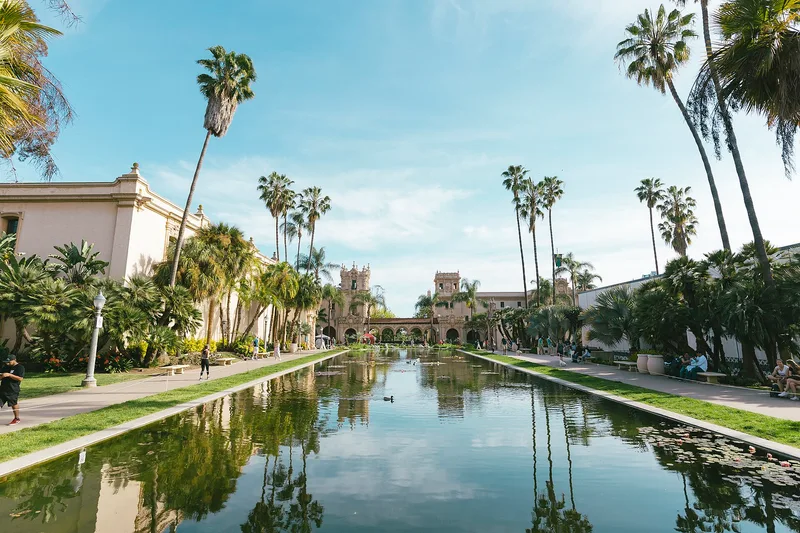
Balboa Park is San Diego's main cultural park, set aside by the city in 1868 as 1,400 acres of undeveloped pueblo land. Its present character stems from the 1915 Panama-California Exposition, planned with architect Bertram Goodhue and built largely by Carleton Winslow, Sr. The El Prado complex includes the California Quadrangle, Cabrillo Bridge, House of Charm, House of Hospitality, Botanical Building, Organ Pavilion, Alcazar Gardens and Plaza de Panama. Many buildings were first meant to be temporary and were later saved or reconstructed. A second fair in 1935, planned by Richard S. Requa, added buildings such as the Art Moderne Ford Building by Walter Dorwin Teague. After the fairs the park became the center of the city's social, cultural and recreational life, and the zoo and several museums grew from exposition exhibits. The nomination presents it as a well-planned, landscaped urban area with outstanding Spanish Baroque revival architecture.
Significance in brief: The nomination calls the park the cultural center of San Diego and one of the best planned and landscaped urban areas in America. Its buildings are described as some of the finest Spanish Baroque revival architecture extant. It also preserves the legacy of two world's fairs that shaped the city's cultural and civic life.
Machine-generated summary. This summary was generated by a language model from the official nomination document and has not been reviewed line by line by an editor. It may contain errors. Check the source document before relying on any detail. Source: nomination document (PDF) · National Archives catalog entry. NRHP reference 77000331, listed December 22, 1977. Summary generated October 2026 (model claude-sonnet-5-5, prompt v1.0-2026-10-29, confidence medium).
Key facts
| Address | CA Quadrangle 41, San Diego |
|---|---|
| County | San Diego County |
| Listed | December 22, 1977 |
| Reference number | 77000331 |
| Resource type | District |
| Period of significance | 1900- (specific dates 1915, 1935) |
| Architect / builder | Bertram Goodhue, Carleton Winslow, Sr., Richard S. Requa, Walter Dorwin Teague |
| Architectural style | Spanish Baroque revival, with Spanish Colonial, Mission and Art Moderne elements |
| Areas of significance | Landscape Architecture, Architecture |
| Level of significance | National |
| National Historic Landmark | Yes, designated December 22, 1977 |
| Status (as stated in the nomination) | Listed condition is good and the original site is unmoved; present uses include park, museum, educational and entertainment. The Ford Building was under restoration at the time. |
| Within district | El Prado Complex |
| Coordinates | 32.73250, -117.14913 (NPS GIS) |
What listing means for this property
This is a historic district. Buildings within its boundary are either contributing (they add to the district's significance) or non-contributing. Owners of contributing income-producing buildings can claim the 20% federal rehabilitation tax credit; homeowners should look at state credits. National Register districts impose no design review by themselves; a local historic district ordinance, if one exists, does (the difference explained).
General information, not legal or tax advice. Rules change; confirm with your State Historic Preservation Office or a qualified adviser.
Sources and further reading
- National Park Service, National Register of Historic Places database (snapshot May 2026), reference 77000331.
- Nomination form (PDF, National Archives) — catalog entry
- Wikipedia article (used for cross-checking only; text not reproduced here)
- Wikidata Q804697
- This listing as JSON
Last updated October 2026. Found an error? See the editorial policy for how to report it.