Wall Street Mill
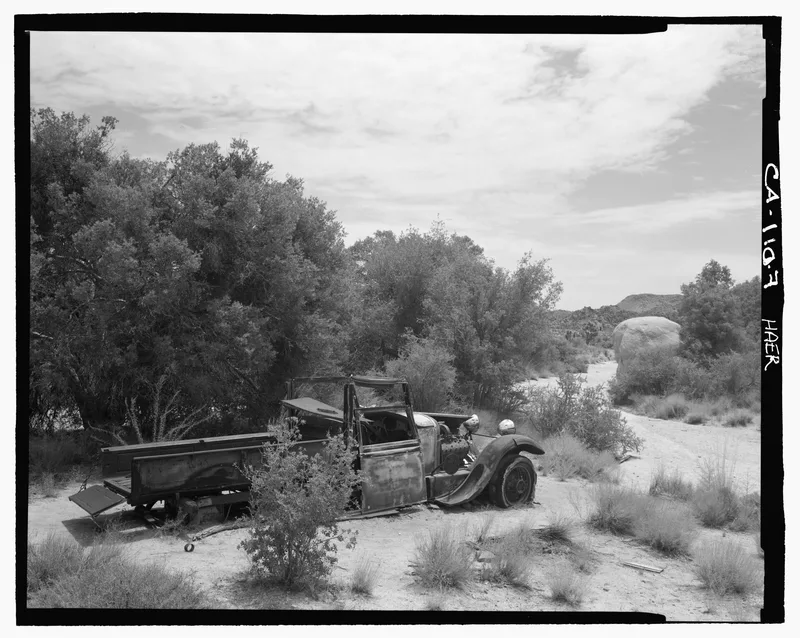
Why it's listed
Wall Street Mill is a gold ore crushing complex south of Twentynine Palms, within Joshua Tree National Monument. Its heavy-timber stamp mill sits on a sloping hillside so gravity aids the milling process, with a wooden ramp carrying an ore tramway to the top of the building. Inside is a two-stamp crusher made by Baker Iron Works of Los Angeles in 1891, a Myer concentrating table and a gasoline engine from the Western Gas Engine Company. The machinery first served at Pinon Wells and later passed to Sherwood & Company before rancher and miner William F. Keys bought it in the early 1930s and moved it here. Keys ran it intermittently for about ten years, crushing ore from his own claims and for other prospectors, and reopened it briefly in 1966. It is valued as a complete, operable example of late-19th-century mining equipment. The collapsed bunk house and privy are not considered significant.
Significance in brief: The nomination argues local technological and mechanical significance under Industry. It is a complete and operable gold ore crushing mill with late-19th-century two-stamp machinery. The significance covers the machinery, the mill building, the well and the well pump, but not the collapsed bunk house or privy.
Machine-generated summary. This summary was generated by a language model from the official nomination document and has not been reviewed line by line by an editor. It may contain errors. Check the source document before relying on any detail. Source: nomination document (PDF) · National Archives catalog entry. NRHP reference 75000176, listed November 12, 1975. Summary generated October 2026 (model claude-sonnet-5-5, prompt v1.0-2026-10-29, confidence high).
Key facts
| Address | S of Twentynine Palms in Joshua Tree National Monument, Twentynine Palms |
|---|---|
| County | San Bernardino County |
| Listed | November 12, 1975 |
| Reference number | 75000176 |
| Resource type | Building |
| Period of significance | c. 1933-present |
| Architect / builder | William F. Keys |
| Areas of significance | Industry |
| Level of significance | Local |
| Status (as stated in the nomination) | Mill building generally in good condition, missing some windows, floor boards and a stair; the bunk house and outhouse are partially or almost totally collapsed. A data sheet notes the property is abandoned and not in use. |
| Acreage | 15 |
| Coordinates | 34.03610, -116.13391 (NPS GIS) |
What listing means for this property
For an income-producing building, listing (individually or as a contributing building in a district) is the gateway to the 20% federal rehabilitation tax credit on qualified rehabilitation costs, often stackable with state credits. Work claiming the credit must follow the Secretary of the Interior's Standards and be approved in advance.
Listing does not restrict a private owner acting without federal money or permits; where federal funding or licensing is involved, Section 106 review applies.
Noted as vacant in the nomination. Nomination documents can be decades old; current status may differ. If you are considering buying an empty listed property, read the due-diligence checklist.
General information, not legal or tax advice. Rules change; confirm with your State Historic Preservation Office or a qualified adviser.
Sources and further reading
- National Park Service, National Register of Historic Places database (snapshot May 2026), reference 75000176.
- Nomination form (PDF, National Archives) — catalog entry
- Wikipedia article (used for cross-checking only; text not reproduced here)
- Wikidata Q7962621
- This listing as JSON
Last updated October 2026. Found an error? See the editorial policy for how to report it.