Redlands Santa Fe Depot District

Why it's listed
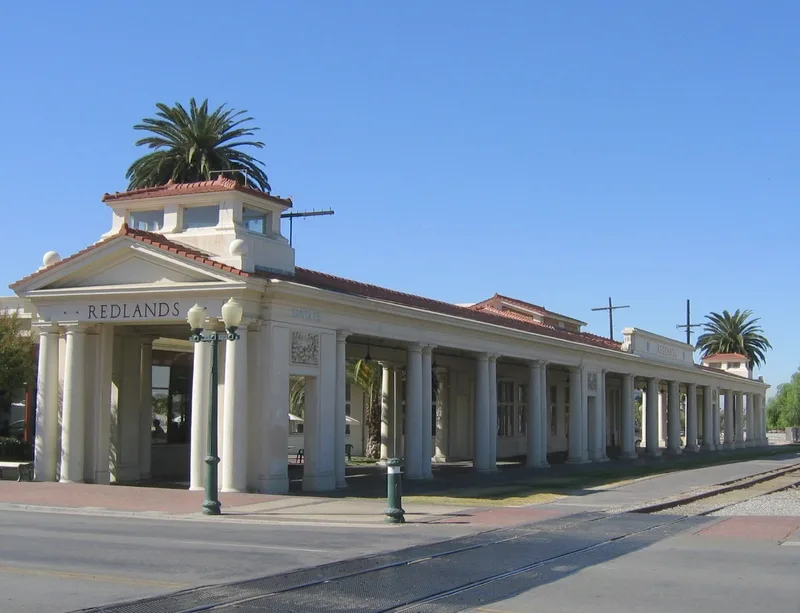
Downtown Redlands' old depot area is a district of brick storefronts, citrus packing houses, warehouses and a railroad station, built between 1888 and 1941. It grew out of the first downtown laid out by the Chicago Colony in 1886, and an 1888 city ordinance required that new downtown buildings be brick. Brick, segmental arch openings and corbeled parapets tie together retail and industrial buildings alike. Landmarks include the 1909 Classical Revival Santa Fe station with its long Doric colonnade, the 1912 Board of Trade building, the 1923 Packard sales office and several packing houses. Alleys behind Orange Street still show the industrial side of the area. The district survived largely intact because commercial activity shifted south to State Street. It was listed for its local significance in architecture, commerce, industry and transportation, as a record of the community's growth through 1941.
Significance in brief: The district kept its integrity as one of Redlands' economic hubs and conveys a sense of time and place as the city's commercial heart. It shows the major phases of local urban development from the 1880s to 1941. It also forms an architectural assemblage with many distinguished buildings and works of local architects and designers.
Machine-generated summary. This summary was generated by a language model from the official nomination document and has not been reviewed line by line by an editor. It may contain errors. Check the source document before relying on any detail. Source: nomination document (PDF) · National Archives catalog entry. NRHP reference 91001535, listed October 29, 1991. Summary generated October 2026 (model claude-sonnet-5-5, prompt v1.0-2026-10-29, confidence medium).
Key facts
| Address | Roughly bounded by Stuart Ave., N. 5th St., Redlands Blvd., Eureka St. and the SFRR tracks, Redlands |
|---|---|
| County | San Bernardino County |
| Listed | October 29, 1991 |
| Reference number | 91001535 |
| Resource type | District |
| Period of significance | 1889-1941 |
| Architectural style | Late Victorian; Late 19th & 20th century Revivals (including Classical Revival depot and Board of Trade building) |
| Criteria |
|
| Areas of significance | Industry, Commerce, Transportation, Architecture |
| Level of significance | Local |
| Status (as stated in the nomination) | Many buildings remain in commercial use. One packing house, the Gregory Packing House, recently burned down. Some facades have been altered. |
| Acreage | 20 |
| Coordinates | 34.05817, -117.18344 (NPS GIS) |
What listing means for this property
This is a historic district. Buildings within its boundary are either contributing (they add to the district's significance) or non-contributing. Owners of contributing income-producing buildings can claim the 20% federal rehabilitation tax credit; homeowners should look at state credits. National Register districts impose no design review by themselves; a local historic district ordinance, if one exists, does (the difference explained).
General information, not legal or tax advice. Rules change; confirm with your State Historic Preservation Office or a qualified adviser.
Sources and further reading
- National Park Service, National Register of Historic Places database (snapshot May 2026), reference 91001535.
- Nomination form (PDF, National Archives) — catalog entry
- Wikipedia article (used for cross-checking only; text not reproduced here)
- Wikidata Q19877458
- This listing as JSON
Last updated October 2026. Found an error? See the editorial policy for how to report it.