Beringer Brothers-Los Hermanos Winery
Also known as: Beringer Winery Historic District
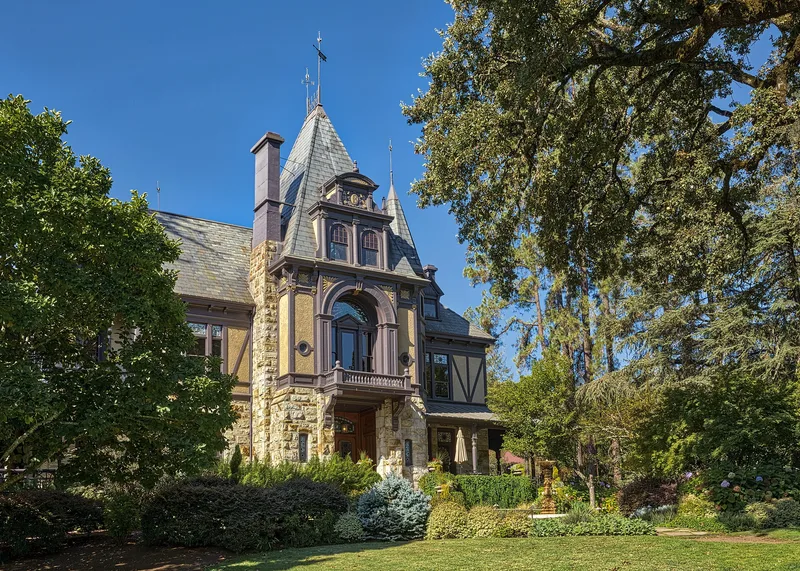

Why it's listed
Beringer Winery Historic District occupies about eight acres along State Highway 29 at the north end of St. Helena. Jacob Beringer bought the land in 1875 and had a two-story stone winery built into the hillside by 1878, with aging tunnels dug into the slope behind it. His brother Frederick joined him in 1883 and commissioned German-born architect Albert Schroepfer to design the half-timbered Rhine House, finished in 1884. The older Hudson House, dating from about 1852, was moved and remodeled. Elm trees planted in 1885 and a stone wall still line the road. After Prohibition ended, the family added winery wings, an expanded office and a second distillery by 1935, and in 1934 the winery became the first in the Napa Valley to offer public tours and sales. The district has six contributing buildings, one contributing site, and keeps the layout of winery, homes and circulation routes that existed when the family ran it.
Significance in brief: The district is described as one of the few Napa Valley winery sites that still retains its winery, support structures, residential areas, vineyard setting and site circulation from its period of significance. It also has extensive hand-dug stone aging tunnels, which are unusual in the valley. The Beringer Brothers winery was the first in the valley to open for public tours and sales, in 1934.
Machine-generated summary. This summary was generated by a language model from the official nomination document and has not been reviewed line by line by an editor. It may contain errors. Check the source document before relying on any detail. Source: nomination document (PDF) · National Archives catalog entry. NRHP reference 01000878, listed August 17, 2001. Summary generated October 2026 (model claude-sonnet-5-5, prompt v1.0-2026-10-29, confidence medium).
Key facts
| Address | 2000 Main St., Saint Helena |
|---|---|
| County | Napa County |
| Listed | August 17, 2001 |
| Reference number | 01000878 |
| Resource type | District |
| Period of significance | 1878 - 1935 |
| Architect / builder | Albert Schroepfer (architect of the Rhine House); built by the Beringer family (Jacob and Frederick Beringer) |
| Architectural style | Late Victorian, Queen Anne, Mission Revival |
| Areas of significance | Agriculture |
| Level of significance | State |
| Status (as stated in the nomination) | Still used for wine processing and as a visitor and sales site; the castle-like distillery was demolished in the 1970s. |
| Acreage | 8 |
| Coordinates | 38.51213, -122.48097 (NPS GIS) |
What listing means for this property
This is a historic district. Buildings within its boundary are either contributing (they add to the district's significance) or non-contributing. Owners of contributing income-producing buildings can claim the 20% federal rehabilitation tax credit; homeowners should look at state credits. National Register districts impose no design review by themselves; a local historic district ordinance, if one exists, does (the difference explained).
General information, not legal or tax advice. Rules change; confirm with your State Historic Preservation Office or a qualified adviser.
Sources and further reading
- National Park Service, National Register of Historic Places database (snapshot May 2026), reference 01000878.
- Nomination form (PDF, National Archives) — catalog entry
- Wikipedia article (used for cross-checking only; text not reproduced here)
- Wikidata Q4891843
- This listing as JSON
Last updated October 2026. Found an error? See the editorial policy for how to report it.