Los Angeles Memorial Coliseum
Also known as: Olympic Stadium (1932)

Why it's listed
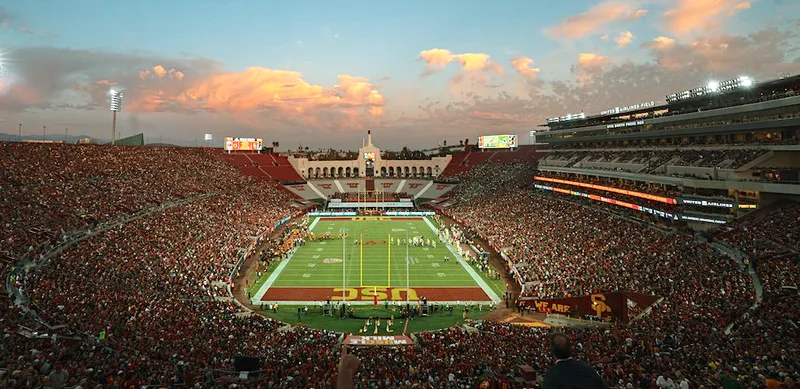
Los Angeles Memorial Coliseum is a giant elliptical bowl of cast-in-place reinforced concrete in Exposition Park, about 1,038 feet long and 738 feet wide. Built in 1921-23 on the slope of a former sand and gravel pit, it was enlarged in 1930-31 with a third bank of seating, raising capacity from 75,000 to nearly 102,000 for the 1932 Olympic Games. Its east end features a Peristyle with a triumphal arch, smaller flanking arches and an Olympic torch added for the Games. Architects John and Donald Parkinson designed it. The 1932 Games drew 40 nations, 124 events and an opening-day crowd of 101,022, and introduced innovations such as the Olympic Village and the victory podium. The stadium has also hosted football, a World Series, rallies, religious services and a wartime victory celebration. Postwar additions by Bennett and Bennett include offices, a press box and dressing rooms, yet the structure still looks much as it did in 1932. It was to host the 1984 Games as well.
Significance in brief: The nomination argues the Coliseum has national and international significance as the central site of the Xth Olympiad, the 1932 Los Angeles Summer Games. It is also significant for the many other sporting and civic events held there over six decades. It is also a key example of work by the prominent Los Angeles architects John and Donald Parkinson.
Machine-generated summary. This summary was generated by a language model from the official nomination document and has not been reviewed line by line by an editor. It may contain errors. Check the source document before relying on any detail. Source: nomination document (PDF) · National Archives catalog entry. NRHP reference 84003866, listed July 27, 1984. Summary generated October 2026 (model claude-sonnet-5-5, prompt v1.0-2026-10-29, confidence medium).
Key facts
| Address | 3911 S. Figueroa St., Los Angeles |
|---|---|
| County | Los Angeles County |
| Listed | July 27, 1984 |
| Reference number | 84003866 |
| Resource type | Structure |
| Period of significance | 1921-23; 1931-32 |
| Architect / builder | John and Donald Parkinson |
| Areas of significance | Entertainment/Recreation |
| Level of significance | National |
| National Historic Landmark | Yes, designated July 27, 1984 |
| Status (as stated in the nomination) | Listed as in excellent condition and occupied; in use as a sports venue, with a new synthetic track and refurbishing done for the 1984 Olympics. |
| Acreage | 18 |
| Coordinates | 34.01401, -118.28778 (NPS GIS) |
What listing means for this property
For a publicly owned building or structure, listing mainly matters when federal funds, permits or licences are involved: projects then go through Section 106 review so effects on the property are considered. Listing also strengthens applications for preservation grants and, for leased income-producing uses, can enable the federal rehabilitation tax credit.
General information, not legal or tax advice. Rules change; confirm with your State Historic Preservation Office or a qualified adviser.
Sources and further reading
- National Park Service, National Register of Historic Places database (snapshot May 2026), reference 84003866.
- Nomination form (PDF, National Archives) — catalog entry
- Wikipedia article (used for cross-checking only; text not reproduced here)
- Wikidata Q849784
- This listing as JSON
Last updated October 2026. Found an error? See the editorial policy for how to report it.