Hearst Greek Theatre

Approximate location: the National Park Service places this pin arbitrarily within the property, not at a surveyed point (stated accuracy ±12 m).
Why it's listed
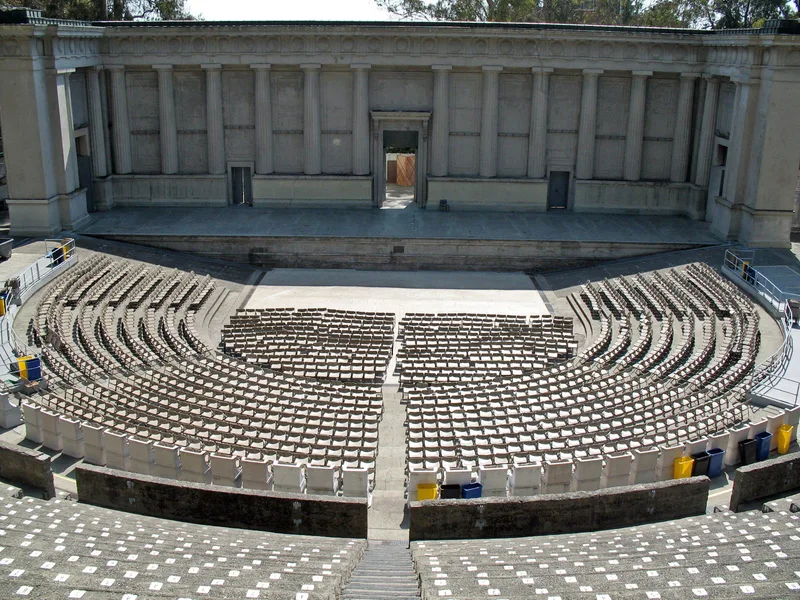
Set in a natural semicircular hollow above Gayley Road on the Berkeley campus, this concrete amphitheatre was designed by John Galen Howard and completed in 1903. Nineteen rows of concrete benches step down toward a high Classical stage wall with Doric columns and a central monumental doorway, and carved stone chairs line the lowest tiers. It seats about 10,000 people. The design was modeled on the theater at Epidaurus, though Howard's plans for caryatids, a double colonnade and marble surfaces proved too costly. William Randolph Hearst funded the conversion of a site long used for student productions, at the urging of President Benjamin Ide Wheeler. Theodore Roosevelt spoke at an early event in May 1903, and the formal dedication that September featured Aristophanes' The Birds in Greek. It was the first permanent outdoor theatre of Greek design in California and remains a symbol of the University. Ernest Born added backstage and lighting improvements in 1957.
Significance in brief: The nomination argues that its architecture and its setting are inseparable, and that it symbolized the intellectual and democratic ideals of the early University. It was the first permanent outdoor theatre modeled on a Greek prototype built in California, and the first of Howard's campus buildings to be completed. The reviewer accepted it under Criteria A and C.
Machine-generated summary. This summary was generated by a language model from the official nomination document and has not been reviewed line by line by an editor. It may contain errors. Check the source document before relying on any detail. Source: nomination document (PDF) · National Archives catalog entry. NRHP reference 82004644, listed March 25, 1982. Summary generated October 2026 (model claude-sonnet-5-5, prompt v1.0-2026-10-29, confidence medium).
Key facts
| Address | Oxford St., Berkeley |
|---|---|
| County | Alameda County |
| Listed | March 25, 1982 |
| Reference number | 82004644 |
| Resource type | Site |
| Period of significance | 1900-present |
| Architect / builder | John Galen Howard, Ernest Born (Additions) |
| Architectural style | Neo-Classic (Greek Classical, modeled on the theater at Epidaurus) |
| Criteria |
|
| Areas of significance | Landscape Architecture, Architecture |
| Level of significance | National |
| Status (as stated in the nomination) | Condition listed as excellent, altered, original site; Ernest Born added dressing rooms, approaches, lighting and a roof in 1957, which the form says do not impair the architectural character. |
| Acreage | 2 |
| Coordinates | 37.87372, -122.25430 (NPS GIS) |
What listing means for this property
Sites (archaeological sites, battlefields, landscapes) are often listed with a restricted address to protect them from looting or disturbance. Listing is honorary for private owners; federal undertakings on or near the site go through Section 106 review, and state laws may protect burials and artefacts regardless of listing.
General information, not legal or tax advice. Rules change; confirm with your State Historic Preservation Office or a qualified adviser.
Sources and further reading
- National Park Service, National Register of Historic Places database (snapshot May 2026), reference 82004644.
- Nomination form (PDF, National Archives) — catalog entry
- Wikipedia article (used for cross-checking only; text not reproduced here)
- Wikidata Q671266
- This listing as JSON
Last updated October 2026. Found an error? See the editorial policy for how to report it.