Roanoke Warehouse Historic District

Why it's listed
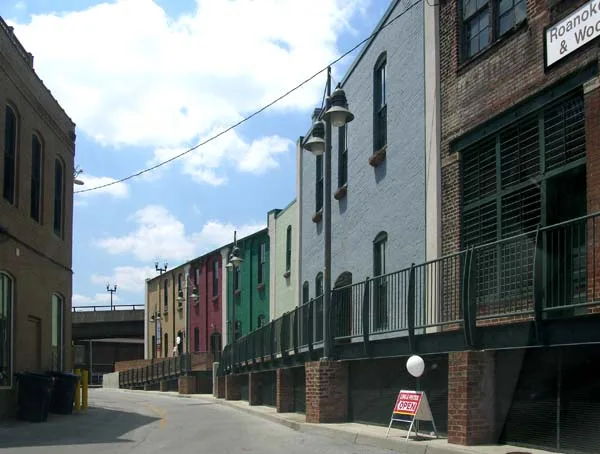
Wholesale Row is a single line of five brick warehouses along Norfolk Avenue SW in Roanoke's Old Southwest area, backed by the Norfolk and Western Railway tracks. Built between 1889 and 1902 to store wholesale food, the two-to-four-story buildings have load-bearing brick walls, interior post-and-beam supports, segmental arched windows and loading docks facing the railroad. Two of them, at 109 and 113 Norfolk Avenue, have steeply pitched roofs with corbeled stepped gables recalling Dutch vernacular buildings. The land was bought by P.L. Terry in 1882, and his milling warehouse began the row. The district matters as a reminder of Roanoke's growth as a railroad town and its turn-of-the-century role as the wholesale center of Southwest Virginia. Grocery wholesaling dominated the row into the 1930s and continued until the last grocer closed in 1981. Despite window and door alterations, the group keeps much of its original character and is the last of its kind near downtown.
Significance in brief: The warehouses are closely tied to Roanoke's rise around 1900 as the wholesale capital of Southwest Virginia. They show the functional tradition of early industrial warehouse design, with heavy brick walls, post-and-beam interiors and loading docks. Two have corbeled stepped gables in a Dutch-vernacular manner. They are the last group of warehouses left on the railway near the central business district.
Machine-generated summary. This summary was generated by a language model from the official nomination document and has not been reviewed line by line by an editor. It may contain errors. Check the source document before relying on any detail. Source: nomination document (PDF) · National Archives catalog entry. NRHP reference 83003313, listed March 29, 1983. Summary generated October 2026 (model claude-sonnet-5-5, prompt v1.0-2026-10-29, confidence high).
Key facts
| Address | 109-133 Norfolk Ave., SW, Roanoke (Independent City) |
|---|---|
| County | Roanoke (city and county) |
| Listed | March 29, 1983 |
| Reference number | 83003313 |
| Resource type | District |
| Period of significance | 1889-1902 |
| Architect / builder | Builder/Architect Unknown |
| Architectural style | Early industrial warehouse design (functional tradition) with Dutch-vernacular stepped gables |
| Areas of significance | Commerce, Architecture |
| Level of significance | State |
| Status (as stated in the nomination) | Some buildings still function partly as warehouses and have been modernized with larger windows and altered doors and rooflines; plans called for rehabilitation as an entertainment and retail center. The last wholesale grocer on the row closed in spring 1981. |
| Acreage | 2.5 |
| Within district | Gainsboro Historic District |
| Coordinates | 37.27316, -79.94337 (NPS GIS) |
What listing means for this property
This is a historic district. Buildings within its boundary are either contributing (they add to the district's significance) or non-contributing. Owners of contributing income-producing buildings can claim the 20% federal rehabilitation tax credit; homeowners should look at state credits. National Register districts impose no design review by themselves; a local historic district ordinance, if one exists, does (the difference explained).
General information, not legal or tax advice. Rules change; confirm with your State Historic Preservation Office or a qualified adviser.
Sources and further reading
- National Park Service, National Register of Historic Places database (snapshot May 2026), reference 83003313.
- Nomination form (PDF, National Archives) — catalog entry
- Wikipedia article (used for cross-checking only; text not reproduced here)
- Wikidata Q16899380
- This listing as JSON
Last updated October 2026. Found an error? See the editorial policy for how to report it.