Bryan, Joseph, Park
Also known as: Young's Pond; 127-5677; Rosewood

Why it's listed
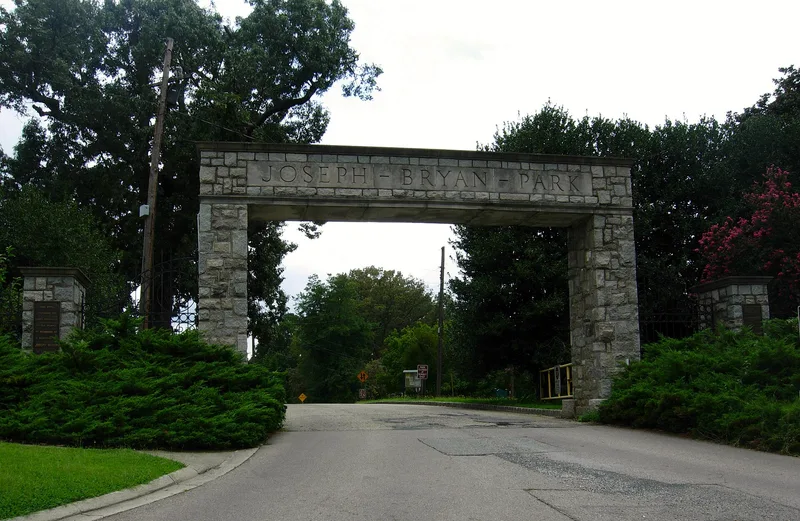
Joseph Bryan Park is a 262-acre public park in Richmond's Northside, built on land with a long record of use. In the late 1700s it was part of the Young family's Westbrook plantation, with a gristmill and millpond at Young's Pond. In 1800, enslaved people met at Young's Spring, where Gabriel's Insurrection was planned. From 1835 the Mordecai family ran the working farm and ice business called Rosewood. After the property was given to the city in 1909 as a memorial to Joseph Bryan, the city turned it into an English naturalistic landscape with ponds, winding roads, woods, a memorial gateway and a gatekeeper's house. Later additions include a 1922 auto-tourist camp house, stone buildings and picnic shelters from the 1930s, and a 17-acre azalea garden begun in 1952 that once drew as many as 400,000 visitors a year. The park was recognized for its history and its landscape design.
Significance in brief: The nomination cites the park's association with Gabriel's Insurrection of 1800, planned at Young's Spring, and its history as the Mordecai family's Rosewood estate. It also argues the park is a good example of English naturalistic landscape design shaped by the City Beautiful movement and rustic park design, with 1920s and 1930s public works additions and a 1950s azalea garden.
Machine-generated summary. This summary was generated by a language model from the official nomination document and has not been reviewed line by line by an editor. It may contain errors. Check the source document before relying on any detail. Source: nomination document (PDF) · National Archives catalog entry. NRHP reference 02001369, listed November 21, 2002. Summary generated October 2026 (model claude-sonnet-5-5, prompt v1.0-2026-10-29, confidence medium).
Key facts
| Address | 4308 Hermitage Rd., Richmond (Independent City) |
|---|---|
| County | Richmond (city and county) |
| Listed | November 21, 2002 |
| Reference number | 02001369 |
| Resource type | District |
| Architect / builder | City of Richmond Park Bureau; Works Projects Administration; Robert H. Harvey (azalea gardens designer) |
| Architectural style | Craftsman / Bungalow Cottage; American Rustic |
| Criteria |
|
| Areas of significance | Landscape Architecture |
| Level of significance | State |
| Status (as stated in the nomination) | Historic fabric is described as largely intact. The two stone comfort stations are closed to the public. The azalea gardens are described as once of statewide significance. |
| Acreage | 262 |
| Coordinates | 37.59148, -77.47377 (NPS GIS) |
What listing means for this property
This is a historic district. Buildings within its boundary are either contributing (they add to the district's significance) or non-contributing. Owners of contributing income-producing buildings can claim the 20% federal rehabilitation tax credit; homeowners should look at state credits. National Register districts impose no design review by themselves; a local historic district ordinance, if one exists, does (the difference explained).
General information, not legal or tax advice. Rules change; confirm with your State Historic Preservation Office or a qualified adviser.
Sources and further reading
- National Park Service, National Register of Historic Places database (snapshot May 2026), reference 02001369.
- Nomination form (PDF, National Archives) — catalog entry
- Wikipedia article (used for cross-checking only; text not reproduced here)
- Wikidata Q4980293
- This listing as JSON
Last updated October 2026. Found an error? See the editorial policy for how to report it.