Boulevard Historic District
Also known as: DHL File #127-398; See Also:Home for Confederate Women; Confed

Why it's listed
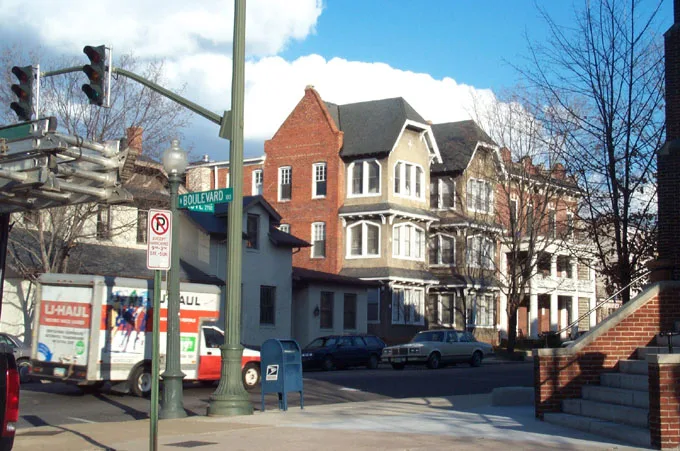
Boulevard Historic District is a tree-lined, thirteen-block corridor in Richmond, Virginia, running along North and South Boulevard on either side of Main Street. Laid out as Clover Street and renamed Boulevard by 1890, it served as a direct route from the Main Street trolley line to Reservoir Park, now Byrd Park. It stayed a minor road until the turn of the century, when nearby land was subdivided for speculative housing. Most building took place between 1910 and 1935, producing town houses, apartment buildings and churches in Colonial Revival, Spanish Eclectic and Tudor Revival styles. Three large public buildings stand on the former grounds of a Confederate veterans' home: Battle Abbey, the Virginia Museum of Fine Arts and the United Daughters of the Confederacy headquarters. Tuscan Villas, built in 1928-29, is a major Mediterranean-influenced apartment complex. The district has 145 contributing buildings and only five noncontributing ones, and it keeps a cohesive appearance, with street trees, lamps and a grassy median.
Significance in brief: The Boulevard is a cohesive early 20th-century streetscape of town houses, apartment buildings and churches in popular styles such as Colonial Revival, Spanish Eclectic and Tudor Revival. It also contains three monumental public buildings of exceptional local architectural significance: Battle Abbey, the Virginia Museum of Fine Arts and the United Daughters of the Confederacy headquarters. It also grew from the former Robert E. Lee Camp No. 1 Confederate veterans' home property. Only five noncontributing buildings intrude, which shows its integrity.
Machine-generated summary. This summary was generated by a language model from the official nomination document and has not been reviewed line by line by an editor. It may contain errors. Check the source document before relying on any detail. Source: nomination document (PDF) · National Archives catalog entry. NRHP reference 86002887, listed September 18, 1986. Summary generated October 2026 (model claude-sonnet-5-5, prompt v1.0-2026-10-29, confidence medium).
Key facts
| Address | 10--300 S. Boulevard and 10--800 N. Boulevard, Richmond (Independent City) |
|---|---|
| County | Richmond (city and county) |
| Listed | September 18, 1986 |
| Reference number | 86002887 |
| Resource type | District |
| Architect / builder | Bissell and Sinkler; Eggers and Higgins; Peebles and Ferguson; Ballou and Justice; Baskervill and Son; Albert L. West; Henry E. Baskervill; Carl Ruehrmund; C. G. Morris; Davis Brothers |
| Architectural style | Colonial Revival, Spanish Eclectic, Tudor Revival, Neo-classical, Classical Revival, Gothic Revival |
| Areas of significance | Community Planning and Development, Military, Architecture |
| Level of significance | State |
| Status (as stated in the nomination) | Occupied, in excellent to fair condition. Some buildings now serve other uses, such as museum, medical, and condominium uses. |
| Acreage | 61 |
| Within district | James River and Kanawha Canal Historic District |
| Coordinates | 37.55389, -77.47581 (NPS GIS) |
What listing means for this property
This is a historic district. Buildings within its boundary are either contributing (they add to the district's significance) or non-contributing. Owners of contributing income-producing buildings can claim the 20% federal rehabilitation tax credit; homeowners should look at state credits. National Register districts impose no design review by themselves; a local historic district ordinance, if one exists, does (the difference explained).
General information, not legal or tax advice. Rules change; confirm with your State Historic Preservation Office or a qualified adviser.
Sources and further reading
- National Park Service, National Register of Historic Places database (snapshot May 2026), reference 86002887.
- Nomination form (PDF, National Archives) — catalog entry
- Wikipedia article (used for cross-checking only; text not reproduced here)
- Wikidata Q14712053
- This listing as JSON
Last updated October 2026. Found an error? See the editorial policy for how to report it.