Prince William County Courthouse
Also known as: Old Manassas Courthouse; 076-5080

Why it's listed
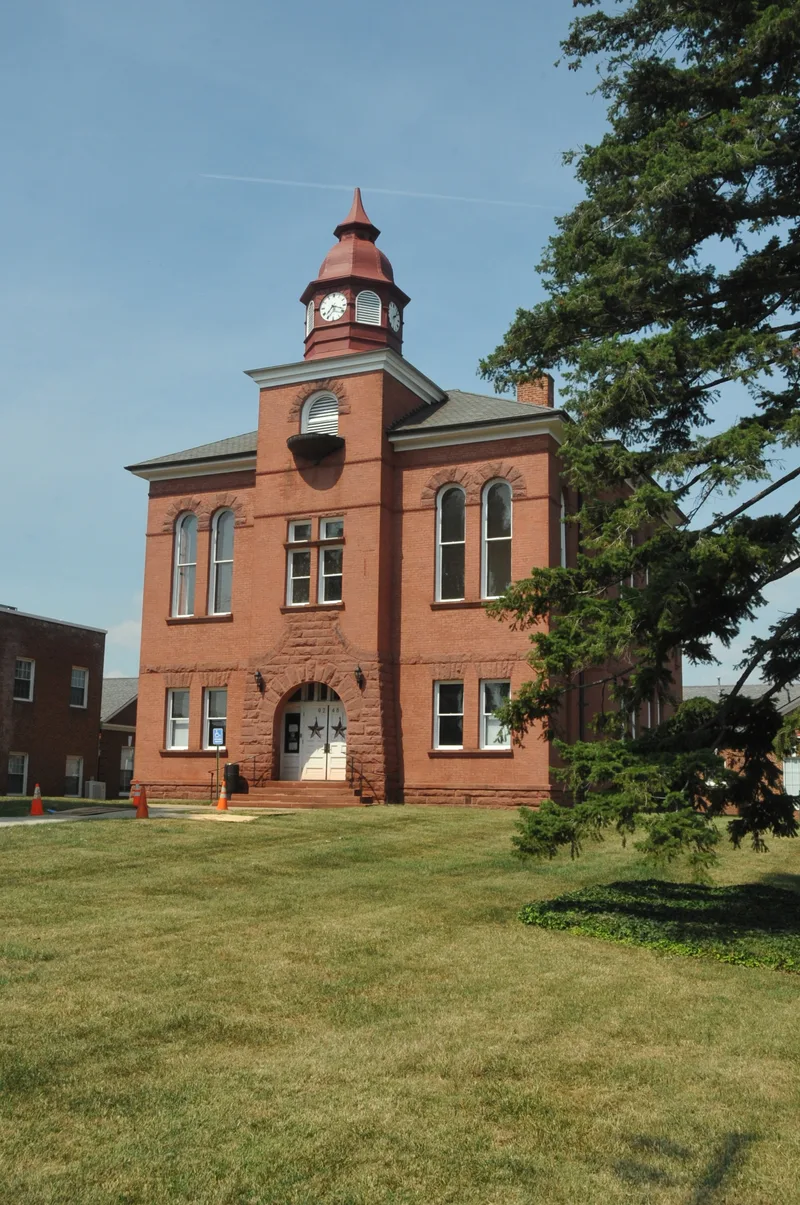
Prince William County's fifth courthouse, completed in 1893 in Manassas, is a square, two-story brick building with rusticated sandstone belt courses, a hipped roof and a three-story clock tower topped by an eight-sided cupola. Its Victorian Romanesque style was a bold choice at a time when nearby buildings leaned toward classical designs, and county officials rejected a Colonial Revival plan before settling on it. The building was constructed after three referendums finally moved the county seat from Brentsville to Manassas, a railroad hub, in 1892. It served the circuit court and Board of County Supervisors until 1984. In 1911 the grounds hosted the Great Peace Jubilee, a reunion of Union and Confederate veterans marking the anniversary of the First Battle of Manassas, and a memorial there was unveiled in 1915. Interiors altered in the 1960s were restored to their 1890s appearance in 2000-2001, and the building again houses court clerk offices.
Significance in brief: It is a rare example of late Victorian Romanesque architecture in a region that favored classical styles, and it marks the county seat's move from Brentsville to Manassas in 1892. The grounds also hosted the 1911 Peace Jubilee of Union and Confederate veterans, commemorated by a monument unveiled in 1915.
Machine-generated summary. This summary was generated by a language model from the official nomination document and has not been reviewed line by line by an editor. It may contain errors. Check the source document before relying on any detail. Source: nomination document (PDF) · National Archives catalog entry. NRHP reference 04000039, listed February 11, 2004. Summary generated October 2026 (model claude-sonnet-5-5, prompt v1.0-2026-10-29, confidence high).
Key facts
| Address | 9248 Lee Ave., Manassas |
|---|---|
| County | Prince William County |
| Listed | February 11, 2004 |
| Reference number | 04000039 |
| Resource type | Building |
| Period of significance | 1892-1954 |
| Architect / builder | Teague, James C., Architect; Marye, Philip T., Architect |
| Architectural style | Late Victorian: Romanesque |
| Criteria |
|
| Areas of significance | Architecture, Politics/Government |
| Level of significance | Local |
| Status (as stated in the nomination) | Restored in 2000-2001 after sitting vacant from 1984; now used as Clerk of the Court offices, with the former courtroom serving as a community room. |
| Acreage | 2.3 |
| Within district | Manassas Historic District |
| Coordinates | 38.75490, -77.47587 (NPS GIS) |
What listing means for this property
For a publicly owned building or structure, listing mainly matters when federal funds, permits or licences are involved: projects then go through Section 106 review so effects on the property are considered. Listing also strengthens applications for preservation grants and, for leased income-producing uses, can enable the federal rehabilitation tax credit.
General information, not legal or tax advice. Rules change; confirm with your State Historic Preservation Office or a qualified adviser.
Sources and further reading
- National Park Service, National Register of Historic Places database (snapshot May 2026), reference 04000039.
- Nomination form (PDF, National Archives) — catalog entry
- Wikipedia article (used for cross-checking only; text not reproduced here)
- Wikidata Q15268624
- This listing as JSON
Last updated October 2026. Found an error? See the editorial policy for how to report it.