Evergreen
Also known as: Evergreen Plantation Manor House; 076-0007
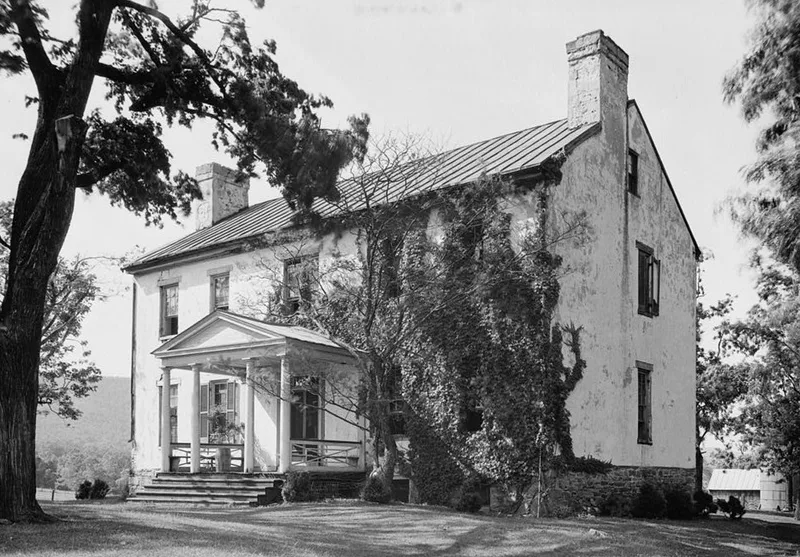

Why it's listed
Evergreen is a stone plantation manor house set on a small knoll in rural Prince William County, Virginia, now surrounded by a country club and golf course. Built circa 1827 in the Greek Revival style, it rises two and one-half stories over an English basement, with stuccoed walls, a central passage, and two-story porticos on the north and south sides. Around 1940 owner Thomas De Lashmutt added stone wings and installed Colonial Revival paneling, fluted trim and mantels on the first floor. The house was once the center of a 1,064-acre plantation. It is recognized for its association with Edmund Berkeley, who lived here from 1845 until 1915. He organized a local agricultural club, raised a company of the Eighth Virginia Infantry that became part of the so-called Berkeley Regiment, rose to lieutenant colonel, and later supported preserving the First Manassas battlefield. The house is also valued as a rare surviving example of its type.
Significance in brief: It is significant under Criterion B for its ownership and use from 1845 to 1915 by Edmund Berkeley, a farmer, Confederate officer and later advocate for preserving the Manassas battlefield. Under Criterion C it is a rare surviving early nineteenth-century Greek Revival plantation house with finely crafted mid-twentieth-century Colonial Revival additions and interiors.
Machine-generated summary. This summary was generated by a language model from the official nomination document and has not been reviewed line by line by an editor. It may contain errors. Check the source document before relying on any detail. Source: nomination document (PDF) · National Archives catalog entry. NRHP reference 08000247, listed March 27, 2008. Summary generated October 2026 (model claude-sonnet-5-5, prompt v1.0-2026-10-29, confidence high).
Key facts
| Address | 15900 Berkeley Dr., Haymarket |
|---|---|
| County | Prince William County |
| Listed | March 27, 2008 |
| Reference number | 08000247 |
| Resource type | Building |
| Period of significance | circa 1827 - circa 1940 |
| Architect / builder | Unknown |
| Architectural style | Greek Revival; Colonial Revival |
| Criteria |
|
| Areas of significance | Architecture, Military |
| Level of significance | Local |
| Status (as stated in the nomination) | The building is currently vacant and used for storage; a community preservation group is making exterior repairs. |
| Acreage | 4 |
| Coordinates | 38.88330, -77.66208 (NPS GIS) |
What listing means for this property
National Register listing is honorary: it recognises significance and does not restrict what a private owner may do without federal money or permits. It unlocks the 20% federal rehabilitation tax credit for income-producing buildings, state credits in many states, and Section 106 review when federal agencies are involved. See what listing means in practice.
Noted as vacant in the nomination. Nomination documents can be decades old; current status may differ. If you are considering buying an empty listed property, read the due-diligence checklist.
General information, not legal or tax advice. Rules change; confirm with your State Historic Preservation Office or a qualified adviser.
Sources and further reading
- National Park Service, National Register of Historic Places database (snapshot May 2026), reference 08000247.
- Nomination form (PDF, National Archives) — catalog entry
- Wikipedia article (used for cross-checking only; text not reproduced here)
- Wikidata Q15217083
- This listing as JSON
Last updated October 2026. Found an error? See the editorial policy for how to report it.