Shenandoah Historic District
Also known as: Vdhr# 69-5209

Why it's listed
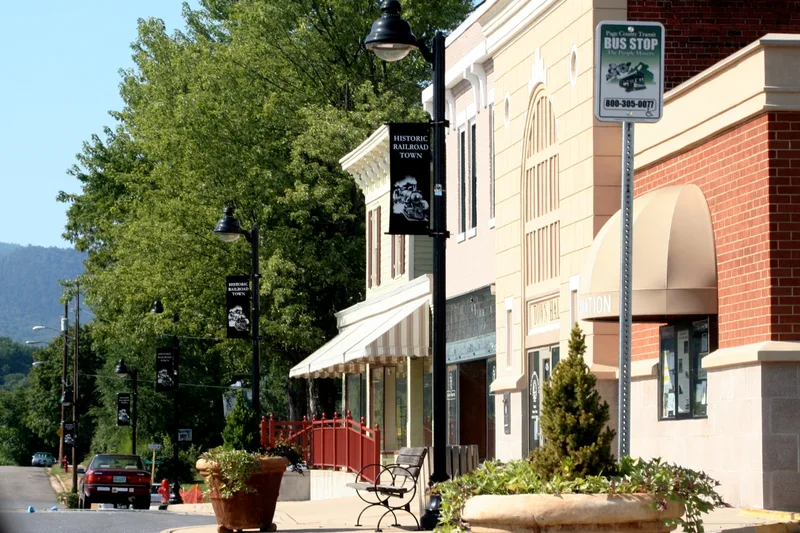
Shenandoah Historic District covers the old core of a small Page County town between the Blue Ridge and Massanutten Ridge, along the South Fork of the Shenandoah River. The community began around an iron furnace in the 1830s, and a great flood in 1870 destroyed most of it. William Milnes, Jr. led the rebuilding and helped bring the Shenandoah Valley Railroad, which reached the town in 1881. The town was laid out on a grid and expanded in the 1890s by the Shenandoah Land and Improvement Company. The district holds about 450 contributing resources, including houses, a commercial row facing the tracks on First Street, seven churches, two cemeteries, a school, a train station, a former fire station and city hall, and a power station with dam. Most buildings are vernacular, with some Queen Anne, Italianate, Colonial Revival and Craftsman examples. The district reflects the town's rise as a rail division point and its later decline.
Significance in brief: The district shows how a railroad and industrial town grew from the post-1870 flood rebuilding led by William Milnes, Jr., through the arrival of the Shenandoah Valley Railroad in 1881 and the land boom of the 1890s. Its buildings, mostly vernacular with some Queen Anne, Italianate, Colonial Revival and Craftsman examples, record that growth. It is significant under Criteria A and C in architecture, transportation and industry.
Machine-generated summary. This summary was generated by a language model from the official nomination document and has not been reviewed line by line by an editor. It may contain errors. Check the source document before relying on any detail. Source: nomination document (PDF) · National Archives catalog entry. NRHP reference 04000554, listed May 27, 2004. Summary generated October 2026 (model claude-sonnet-5-5, prompt v1.0-2026-10-29, confidence medium).
Key facts
| Address | Parts of First,Second,Third,Fourth,Fith,Sixth,Seventh,Eight Denver,Long,H,Sts, Central,Maryland, Penn, and Virg. Aves., Shenandoah |
|---|---|
| County | Page County |
| Listed | May 27, 2004 |
| Reference number | 04000554 |
| Resource type | District |
| Period of significance | 1880-1954 |
| Architect / builder | William M. Poindexter; Alba K. Simmons; George R. Ragan |
| Architectural style | Late Victorian (Queen Anne, Second Gothic Revival, Italianate); Colonial Revival; Tudor Revival; Bungalow/Craftsman; I-house |
| Criteria |
|
| Areas of significance | Architecture, Transportation, Industry |
| Level of significance | Local |
| Status (as stated in the nomination) | Some buildings are in use as dwellings, apartments, a museum, town functions and shops. The Eagle Hotel is abandoned and deteriorated, and First Street is described as somewhat neglected. The town is pursuing revitalization. |
| Acreage | 198 |
| Coordinates | 38.48815, -78.62412 (NPS GIS) |
What listing means for this property
This is a historic district. Buildings within its boundary are either contributing (they add to the district's significance) or non-contributing. Owners of contributing income-producing buildings can claim the 20% federal rehabilitation tax credit; homeowners should look at state credits. National Register districts impose no design review by themselves; a local historic district ordinance, if one exists, does (the difference explained).
General information, not legal or tax advice. Rules change; confirm with your State Historic Preservation Office or a qualified adviser.
Sources and further reading
- National Park Service, National Register of Historic Places database (snapshot May 2026), reference 04000554.
- Nomination form (PDF, National Archives) — catalog entry
- Wikipedia article (used for cross-checking only; text not reproduced here)
- Wikidata Q15277139
- This listing as JSON
Last updated October 2026. Found an error? See the editorial policy for how to report it.