Mauck's Meetinghouse
Also known as: Mill Creek Church

Why it's listed
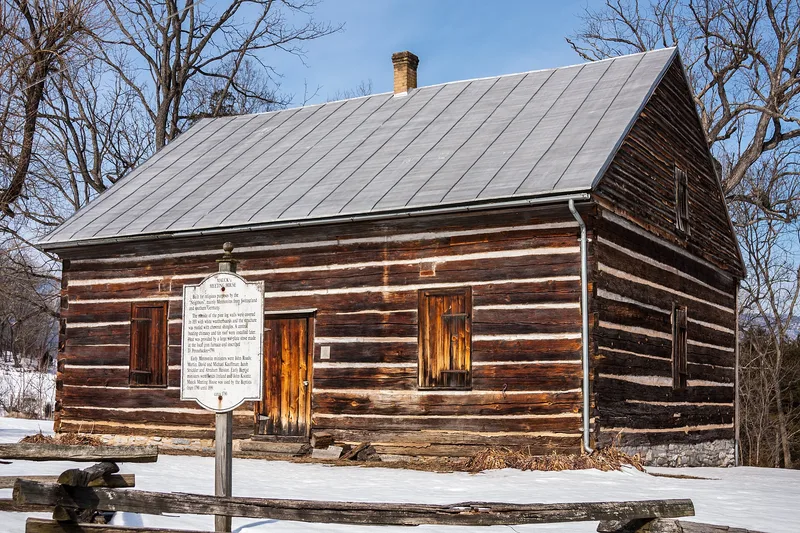
Mauck's Meeting House, also known as Mill Creek Church, is a planked log building above Mill Creek near Hamburg in Page County, Virginia. Built between 1795 and 1800 by a combined Mennonite and Baptist congregation, it measures roughly thirty-six by twenty-nine feet. Its hewn logs are joined with precise half and full dovetail notching. Around 1830 the building was remodeled with weatherboarding, a raised roof, and flanking gable-end balconies with chamfered columns and open stairs. Inside, the logs are whitewashed, and a cast-iron stove signed in 1799 is on display. The congregation was probably organized around 1772 by John Koontz. In 1807 landowner Joseph Mauck deeded the property for use by all orders of Christians, though Baptists came to occupy it almost exclusively. Church minutes record both enslaved people and free people of color among its nineteenth-century members. The building is valued as a well-executed example of plank-log construction, unusual at this scale, and as a reminder of dissenting religious life in the early Shenandoah Valley.
Significance in brief: The building is noted as a well-executed example of plank-log construction, unusual in a building of such large size. It also symbolizes the influential role of dissenters, especially Mennonites and Baptists, in the early society of the Shenandoah Valley.
Machine-generated summary. This summary was generated by a language model from the official nomination document and has not been reviewed line by line by an editor. It may contain errors. Check the source document before relying on any detail. Source: nomination document (PDF) · National Archives catalog entry. NRHP reference 76002116, listed June 18, 1976. Summary generated October 2026 (model claude-sonnet-5-5, prompt v1.0-2026-10-29, confidence high).
Key facts
| Address | Off U.S. 211, Hamburg |
|---|---|
| County | Page County |
| Listed | June 18, 1976 |
| Reference number | 76002116 |
| Resource type | Building |
| Period of significance | 1700-1799, 1800-1899 |
| Architectural style | Log construction with Federal elements |
| Areas of significance | Other, Architecture |
| Level of significance | State |
| Status (as stated in the nomination) | Condition listed as good and altered, on its original site; the foundation has been rebuilt and the building leveled. Present use is religious, and the form notes a work-in-progress status. |
| Acreage | 0.9 |
| Coordinates | 38.65853, -78.51234 (NPS GIS) |
What listing means for this property
Religious properties are listed for their architectural or historical significance, not their religious use. Listing is honorary and does not restrict the congregation's use of the building. The federal rehabilitation credit is generally unavailable unless part of the building is income-producing; some state programmes and preservation grants do cover religious buildings. Federal funding or permits trigger Section 106 review.
General information, not legal or tax advice. Rules change; confirm with your State Historic Preservation Office or a qualified adviser.
Sources and further reading
- National Park Service, National Register of Historic Places database (snapshot May 2026), reference 76002116.
- Nomination form (PDF, National Archives) — catalog entry
- Wikipedia article (used for cross-checking only; text not reproduced here)
- Wikidata Q15251972
- This listing as JSON
Last updated October 2026. Found an error? See the editorial policy for how to report it.