Kenmure
Also known as: Lamb, William, House

Why it's listed
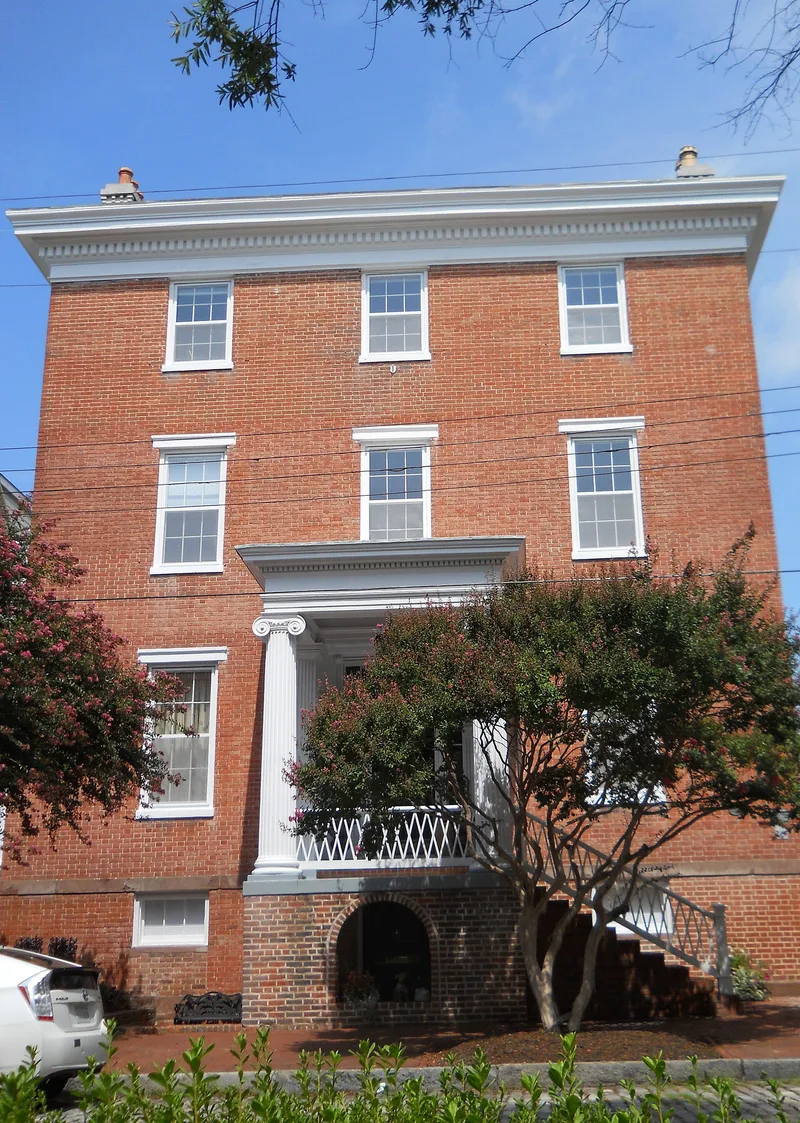
Kenmure is a large brick town house at 420 West Bute Street in Norfolk, built in 1845 for banker and merchant William Wilson Lamb and raised from two stories to three around 1855. Its three-bay front has a small portico with two fluted Ionic columns, a dentil cornice, and a cupola that looks out toward the Elizabeth River. Inside, wide battered door and window trim, two open-string staircases and marble mantels carry the Greek Revival character. The nomination calls it the most distinguished Greek Revival town house in Norfolk. Lamb served as mayor during the Civil War, and local tradition says he hid the city's mace beneath a second-floor hearth. His son William Lamb, defender of Fort Fisher, later lived there, served as mayor, led the state Republican Party and promoted cotton trade with England. After years as apartments, the house was restored in 1977 and now combines offices with a residence.
Significance in brief: The nomination calls it the most distinguished Greek Revival town house in Norfolk and a rare surviving antebellum mansion in the city. It is tied to the Lamb family, leading Norfolk merchants, bankers and mayors. William Wilson Lamb, mayor during the Civil War, is said to have hidden the city's mace there, and his son William Lamb was a Confederate officer, mayor, state Republican chairman and promoter of Norfolk's trade.
Machine-generated summary. This summary was generated by a language model from the official nomination document and has not been reviewed line by line by an editor. It may contain errors. Check the source document before relying on any detail. Source: nomination document (PDF) · National Archives catalog entry. NRHP reference 88000601, listed June 1, 1988. Summary generated October 2026 (model claude-sonnet-5-5, prompt v1.0-2026-10-29, confidence high).
Key facts
| Address | 420 W. Bute St., Norfolk (Independent City) |
|---|---|
| County | Norfolk |
| Listed | June 1, 1988 |
| Reference number | 88000601 |
| Resource type | Building |
| Period of significance | 1845-1909 |
| Architect / builder | Unknown (built for William Wilson Lamb) |
| Architectural style | Greek Revival |
| Criteria |
|
| Areas of significance | Commerce, Politics/Government, Architecture |
| Level of significance | State |
| Status (as stated in the nomination) | Restored in 1977; the basement and first floor serve as professional offices and the upper two floors as a residence. The form describes it as maintained in first-class condition. |
| Acreage | 0.9 |
| Within district | West Freemason Street Area Historic District (Additional Documentation) |
| Coordinates | 36.85281, -76.29666 (NPS GIS) |
What listing means for this property
National Register listing is honorary: it recognises significance and does not restrict what a private owner may do without federal money or permits. It unlocks the 20% federal rehabilitation tax credit for income-producing buildings, state credits in many states, and Section 106 review when federal agencies are involved. See what listing means in practice.
General information, not legal or tax advice. Rules change; confirm with your State Historic Preservation Office or a qualified adviser.
Sources and further reading
- National Park Service, National Register of Historic Places database (snapshot May 2026), reference 88000601.
- Nomination form (PDF, National Archives) — catalog entry
- Wikipedia article (used for cross-checking only; text not reproduced here)
- Wikidata Q16893255
- This listing as JSON
Last updated October 2026. Found an error? See the editorial policy for how to report it.