West Freemason Street Area Historic District (Additional Documentation)

Why it's listed
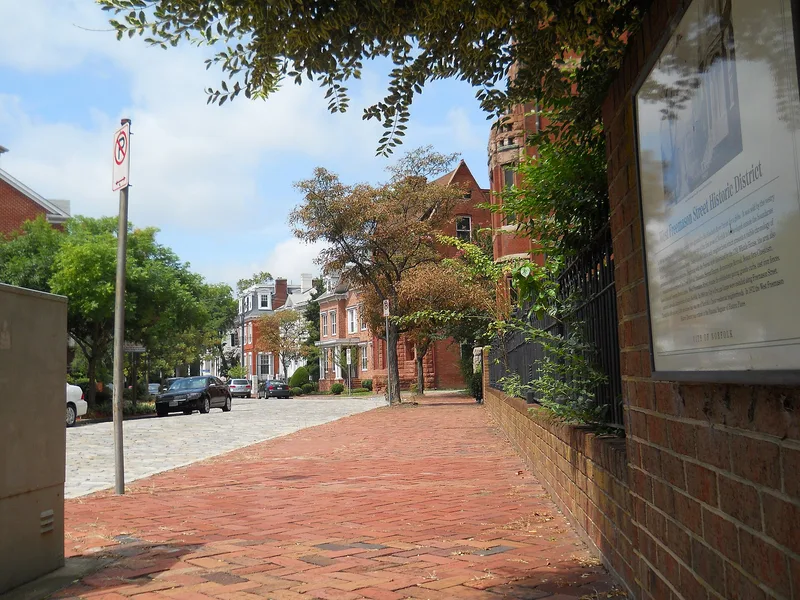
West Freemason Street Area is a compact neighborhood of about fourteen blocks on the western edge of downtown Norfolk, between the Elizabeth River and Boush Street. Laid out just after the Revolution, it contains townhouses built from the late eighteenth century into the early twentieth, including Federal, Greek Revival, Italianate, Second Empire, Queen Anne and Georgian Revival examples. Most are three- or five-bay dwellings set close to the street on deep, narrow lots. Nineteenth-century details survive, such as stone paving at the end of West Freemason Street and fine cast iron fences and verandas. The district matters because Norfolk's other old residential neighborhoods were cleared in the 1960s, leaving this as the city's only early residential streetscape. Individual houses carry their own stories: the 1807 Selden House served as Federal headquarters from 1862 to 1865, the Whittle House was home to Captain Richard Lucien Page, and the Allmand-Archer House housed American officers in the War of 1812.
Machine-generated summary. This summary was generated by a language model from the official nomination document and has not been reviewed line by line by an editor. It may contain errors. Check the source document before relying on any detail. Source: nomination document (PDF) · catalog entry. Generated October 2026 (model claude-sonnet-5-5, prompt v1.0-2026-10-29).
| Styles | Range of townhouse styles from Federal through Greek Revival, Italianate, Second Empire, Romanesque Revival, Queen Anne, Beaux Arts Classicism and Georgian Revival |
|---|---|
| Areas of significance | Community Planning and Development, Military, Architecture, Social History |
| Acreage | 40 |
| Boundary source | NPS cultural-resource GIS polygon |
| Full listing page | West Freemason Street Area Historic District (Additional Documentation) (property record) |
What listing means for this property
This is a historic district. Buildings within its boundary are either contributing (they add to the district's significance) or non-contributing. Owners of contributing income-producing buildings can claim the 20% federal rehabilitation tax credit; homeowners should look at state credits. National Register districts impose no design review by themselves; a local historic district ordinance, if one exists, does (the difference explained).
General information, not legal or tax advice. Rules change; confirm with your State Historic Preservation Office or a qualified adviser.