St. Mary's Whitechapel

Why it's listed
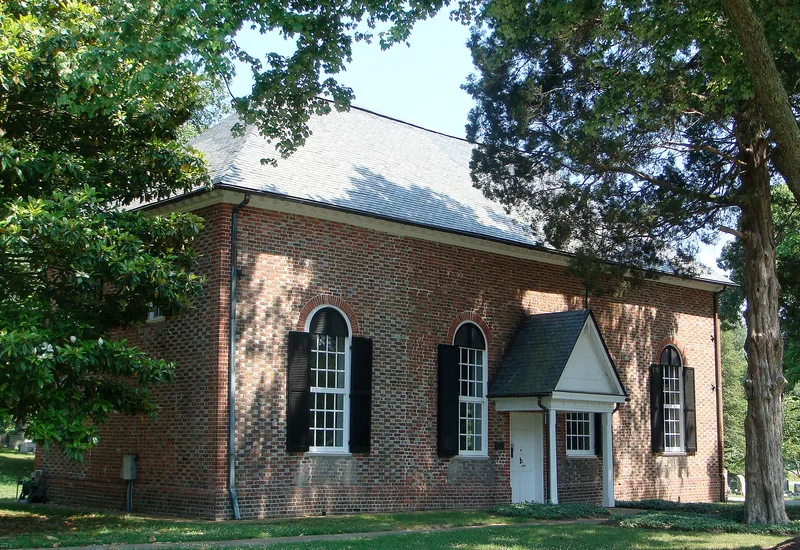
St. Mary's Whitechapel is a rectangular brick church of about 64 by 29 feet in Lancaster County, Virginia. The parish took its name from the Whitechapel district of London, home to some early communicants, and a church stood on the site by 1669. The surviving walls were built as transepts of a cruciform church in 1740-41 under a contract with James Jones. After the building was abandoned following the Disestablishment, it was repaired and reoccupied in 1832. The nave and chancel were removed, and their bricks filled the gaps between the transepts, which became a smaller church. Inside, the south gallery with its Tuscan columns is the only colonial woodwork remaining and the only surviving side gallery in a Virginia colonial church. The churchyard contains altar-tombs of the Ball family; Mary Ball, mother of George Washington, worshipped here. The church still holds a communion set from 1669, a stone font from 1718 and a vestry book of 1739-88.
Significance in brief: The surviving portions are significant as remnants of one of Virginia's more important colonial churches, even though they were severely altered in 1832. The south gallery is the only surviving side gallery in a Virginia colonial church. The churchyard holds altar-tombs of the Ball family, and Mary Ball, mother of George Washington, was a parishioner.
Machine-generated summary. This summary was generated by a language model from the official nomination document and has not been reviewed line by line by an editor. It may contain errors. Check the source document before relying on any detail. Source: nomination document (PDF) · National Archives catalog entry. NRHP reference 69000254, listed November 12, 1969. Summary generated October 2026 (model claude-sonnet-5-5, prompt v1.0-2026-10-29, confidence medium).
Key facts
| Address | NW of jct. of Rtes. 354 and 201, Lively |
|---|---|
| County | Lancaster County |
| Listed | November 12, 1969 |
| Reference number | 69000254 |
| Resource type | Building |
| Period of significance | 17th, 18th and 19th centuries (boxes checked) |
| Architect / builder | James Jones (contractor, 1740-41) |
| Areas of significance | Architecture |
| Level of significance | State |
| Status (as stated in the nomination) | Listed as occupied and in use for religious purposes; condition marked fair; the burying ground is still in use. |
| Acreage | 8 |
| Coordinates | 37.74238, -76.54776 (NPS GIS) |
What listing means for this property
National Register listing is honorary: it recognises significance and does not restrict what a private owner may do without federal money or permits. It unlocks the 20% federal rehabilitation tax credit for income-producing buildings, state credits in many states, and Section 106 review when federal agencies are involved. See what listing means in practice.
General information, not legal or tax advice. Rules change; confirm with your State Historic Preservation Office or a qualified adviser.
Sources and further reading
- National Park Service, National Register of Historic Places database (snapshot May 2026), reference 69000254.
- Nomination form (PDF, National Archives) — catalog entry
- Wikipedia article (used for cross-checking only; text not reproduced here)
- Wikidata Q7590053
- This listing as JSON
Last updated October 2026. Found an error? See the editorial policy for how to report it.