Downtown Hopewell Historic District
Also known as: DHR File No. 116-5031
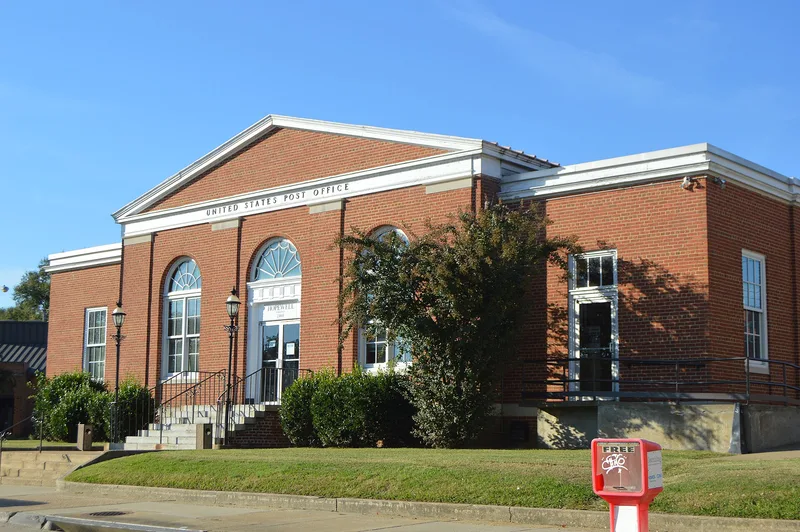

Why it's listed
Downtown Hopewell, Virginia, was rebuilt in masonry after a disastrous 1915 fire destroyed the frame buildings of its earlier commercial area. This 8.5-acre district holds 50 resources, 38 of them contributing, including shops, banks, hotels, a theatre, a post office, a school and the Municipal Building. Most buildings date from 1916 to 1930, stand one to four stories tall, and sit close to the sidewalk, with government buildings set back behind small lawns. Details include decorative brick cornices, keystones, Ionic and Doric columns, and Art Deco ornament. Architects Fred A. Bishop and Osbert L. Edwards designed several landmarks, among them the Classical Revival Municipal Building of 1925, the Beacon Theatre of 1928 and the D. L. Elder Bank of 1929. Although storefronts have been modernized and some blocks were cleared during urban renewal, the area still conveys its history as a boomtown that grew into a lasting city. The district's significance spans 1915 to 1951.
Significance in brief: The district is argued significant under Criteria A and C for its role in the commerce and government of Hopewell, a one-time boomtown that became a solid city, and for its early twentieth-century masonry architecture. It retains the commercial and governmental buildings that rose after the 1915 fire destroyed the earlier frame downtown.
Machine-generated summary. This summary was generated by a language model from the official nomination document and has not been reviewed line by line by an editor. It may contain errors. Check the source document before relying on any detail. Source: nomination document (PDF) · National Archives catalog entry. NRHP reference 02000977, listed September 14, 2002. Summary generated October 2026 (model claude-sonnet-5-5, prompt v1.0-2026-10-29, confidence medium).
Key facts
| Address | Boundary includes Main St., Appomattox St., Hopewell St., and East Broadway, Hopewell (Independent City) |
|---|---|
| County | Hopewell |
| Listed | September 14, 2002 |
| Reference number | 02000977 |
| Resource type | District |
| Period of significance | 1915-1951 |
| Architect / builder | Fred A. Bishop; Osbert L. Edwards |
| Architectural style | Late 19th and 20th Century Revivals: Colonial Revival, Classical Revival; Modern Movement: Art Deco |
| Criteria |
|
| Areas of significance | Commerce, Politics/Government, Architecture |
| Level of significance | Local |
| Status (as stated in the nomination) | Many storefronts have been altered, some buildings were demolished during urban renewal, and the Beacon Theatre is undergoing restoration. Current functions include commerce, government and a vacant listing. |
| Acreage | 8.5 |
| Coordinates | 37.30644, -77.28683 (NPS GIS) |
What listing means for this property
This is a historic district. Buildings within its boundary are either contributing (they add to the district's significance) or non-contributing. Owners of contributing income-producing buildings can claim the 20% federal rehabilitation tax credit; homeowners should look at state credits. National Register districts impose no design review by themselves; a local historic district ordinance, if one exists, does (the difference explained).
General information, not legal or tax advice. Rules change; confirm with your State Historic Preservation Office or a qualified adviser.
Sources and further reading
- National Park Service, National Register of Historic Places database (snapshot May 2026), reference 02000977.
- Nomination form (PDF, National Archives) — catalog entry
- Wikipedia article (used for cross-checking only; text not reproduced here)
- Wikidata Q15214952
- This listing as JSON
Last updated October 2026. Found an error? See the editorial policy for how to report it.