Meadow Farm

Why it's listed
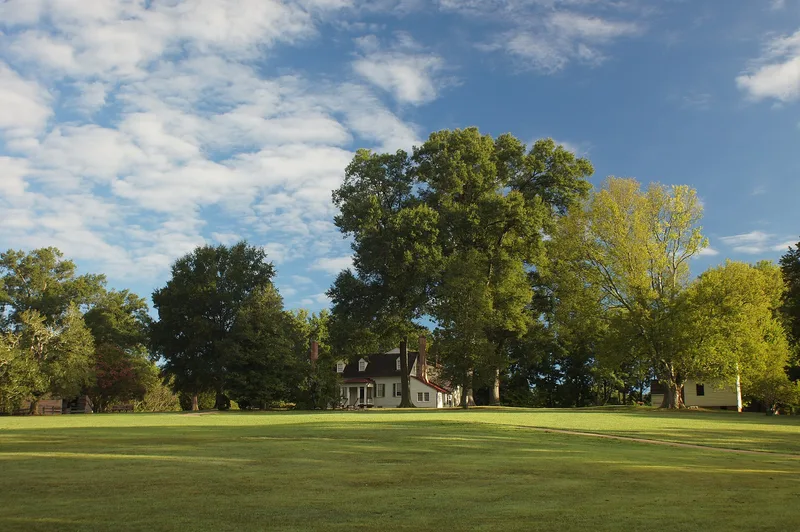
Meadow Farm is a late-eighteenth-century plantation house in Henrico County near Glen Allen, Virginia. The story-and-a-half frame dwelling has a gable roof, gable dormers, brick chimneys at the exterior ends and a single-pile plan. Its box cornices, beaded weatherboarding, louvered blinds and nine-over-nine windows survive, and a country Greek Revival porch likely dates from the 1840s. Inside, the stair, Federal mantels and cross-and-Bible doors remain largely unaltered. The property is also tied to a notable event. On August 30, 1800, owner Mosby Sheppard was warned by two of his servants that slaves on a neighboring farm were planning an insurrection led by Gabriel. He alerted Governor James Monroe, who took precautions to stop it. The two servants, Pharioh and Tom, were later bought by the Commonwealth and freed. The Sheppard family and its descendants kept the farm for almost two hundred years.
Significance in brief: The house is a typical late-eighteenth-century residence for a small Virginia plantation with largely intact early fabric. It is also tied to the Sheppard family, whose member Mosby Sheppard warned of Gabriel's planned slave rebellion in 1800 and notified Governor James Monroe.
Machine-generated summary. This summary was generated by a language model from the official nomination document and has not been reviewed line by line by an editor. It may contain errors. Check the source document before relying on any detail. Source: nomination document (PDF) · National Archives catalog entry. NRHP reference 74002125, listed August 13, 1974. Summary generated October 2026 (model claude-sonnet-5-5, prompt v1.0-2026-10-29, confidence medium).
Key facts
| Address | Mountain and Courtney Rds., Glen Allen |
|---|---|
| County | Henrico County |
| Listed | August 13, 1974 |
| Reference number | 74002125 |
| Resource type | Building |
| Period of significance | 18th and 19th centuries |
| Architectural style | Late eighteenth-century Virginia plantation house with a simple country Greek Revival porch |
| Areas of significance | Military, Black, Architecture |
| Level of significance | State |
| Status (as stated in the nomination) | Described as in generally good preservation but in need of repair; listed as a privately owned residence. Later records mention restoration work. |
| Acreage | 175 |
| Within district | Warminster Rural Historic District |
| Coordinates | 37.67638, -77.51678 (NPS GIS) |
What listing means for this property
National Register listing is honorary for a privately owned home: it does not by itself restrict what an owner may do with their own money, and it does not require public access. Restrictions come from local landmark or historic-district ordinances, which are separate (how they differ).
Owner-occupied houses are not eligible for the 20% federal rehabilitation tax credit, which applies to income-producing buildings, but many states offer credits for homeowners. Listing also opens the door to preservation easements and to buying a plaque. Start with what listing means for homeowners, renovating a listed house and selling one.
General information, not legal or tax advice. Rules change; confirm with your State Historic Preservation Office or a qualified adviser.
Sources and further reading
- National Park Service, National Register of Historic Places database (snapshot May 2026), reference 74002125.
- Nomination form (PDF, National Archives) — catalog entry
- Wikipedia article (used for cross-checking only; text not reproduced here)
- Wikidata Q6803233
- This listing as JSON
Last updated October 2026. Found an error? See the editorial policy for how to report it.