Variable Density Tunnel

Why it's listed
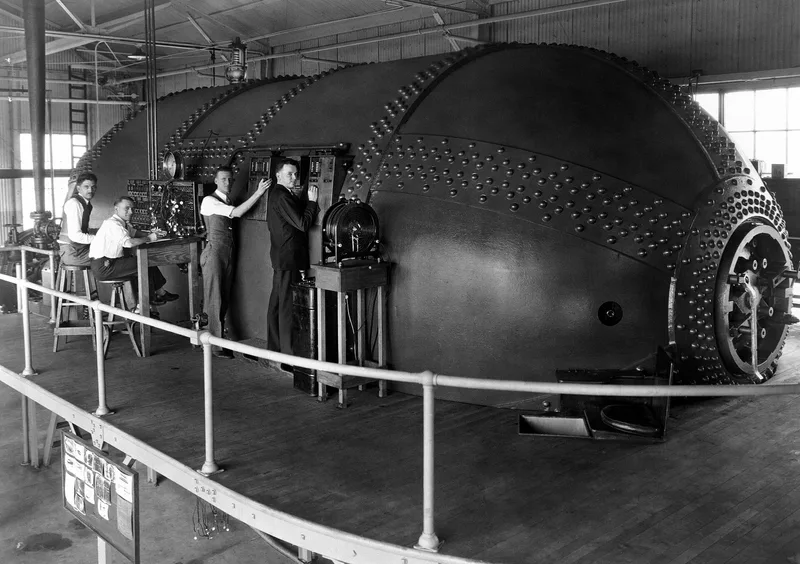
Inside Building 582 at NASA's Langley Research Center in Hampton, Virginia, a large steel pressure tank holds the Variable Density Tunnel, built between 1921 and 1923 for the National Advisory Committee for Aeronautics. Newport News Shipbuilding & Dry Dock Co. made the riveted tank, which is 34.5 feet long and 15 feet in diameter and built to withstand 21 atmospheres. Its purpose was to solve a problem in aircraft testing: results from scale models in ordinary wind tunnels did not match full-size flight because the Reynolds number differed. Compressing the air let a small model reproduce full-scale conditions. Max Munk, a NACA technical assistant, advocated the concept. The tunnel gave NACA a research tool superior to any elsewhere, and its data on 78 airfoil sections influenced aircraft such as the DC-3, B-17 and P-38. A fire damaged the interior in 1927, and it was rebuilt by 1930. It was declared potentially unsafe in 1978 and now sits unused.
Significance in brief: The nomination argues that the tunnel was the first facility to establish NACA as a technically competent research organization. By varying air pressure, it let engineers match full-scale flight conditions using small scale models. Its data fed into designs of aircraft such as the DC-3, B-17 and P-38.
Machine-generated summary. This summary was generated by a language model from the official nomination document and has not been reviewed line by line by an editor. It may contain errors. Check the source document before relying on any detail. Source: nomination document (PDF) · National Archives catalog entry. NRHP reference 85002795, listed October 3, 1985. Summary generated October 2026 (model claude-sonnet-5-5, prompt v1.0-2026-10-29, confidence medium).
Key facts
| Address | Langley Research Center, Hampton (Independent City) |
|---|---|
| County | Hampton |
| Listed | October 3, 1985 |
| Reference number | 85002795 |
| Resource type | Structure |
| Period of significance | 1921-1940 |
| Architect / builder | Max Munk |
| Areas of significance | Other, Engineering, Science |
| Level of significance | National |
| National Historic Landmark | Yes, designated October 3, 1985 |
| Status (as stated in the nomination) | Basic structure remains intact; declared potentially unsafe for operations in 1978, with no plans for its use. Present use is listed as abandoned. |
| Acreage | 0.9 |
| Coordinates | 37.07880, -76.34382 (NPS GIS) |
What listing means for this property
National Register listing is honorary: it recognises significance and does not restrict what a private owner may do without federal money or permits. It unlocks the 20% federal rehabilitation tax credit for income-producing buildings, state credits in many states, and Section 106 review when federal agencies are involved. See what listing means in practice.
Noted as vacant in the nomination. Nomination documents can be decades old; current status may differ. If you are considering buying an empty listed property, read the due-diligence checklist.
General information, not legal or tax advice. Rules change; confirm with your State Historic Preservation Office or a qualified adviser.
Sources and further reading
- National Park Service, National Register of Historic Places database (snapshot May 2026), reference 85002795.
- Nomination form (PDF, National Archives) — catalog entry
- Wikipedia article (used for cross-checking only; text not reproduced here)
- Wikidata Q7915697
- This listing as JSON
Last updated October 2026. Found an error? See the editorial policy for how to report it.