Rendezvous Docking Simulator
Also known as: Real-Time Dynamic Simulator

Why it's listed
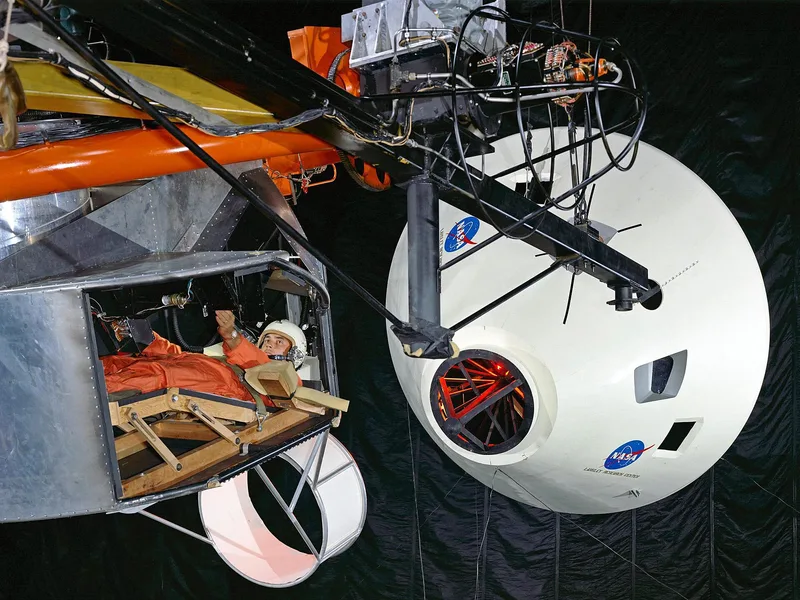
Built in 1963 atop Building 1244 at NASA's Langley Research Center in Hampton, Virginia, this full-scale simulator was used to practice docking spacecraft. It consists of an overhead carriage and a cable-suspended gimbal system. The electrically driven carriage moves in three translational directions, while the hydraulically driven gimbal rotates in three, giving pilots six degrees of freedom through a ground-based analog computer. Its operating volume was 210 feet by 15 feet by 40 feet, and full-scale Gemini or Apollo modules could be hung from it. Pilots practiced Gemini docking with the Agena target and Apollo Lunar Excursion Module docking with the Command Module. The facility matters because the lunar orbit rendezvous plan required flawless docking, and failure could have cost the mission and the astronauts' lives. After Apollo it was modified for aircraft landing and ride quality studies and renamed the Real-Time Dynamic Simulator. It is no longer in use.
Significance in brief: The simulator let NASA train Gemini and Apollo astronauts in spacecraft docking procedures in a safe three-dimensional setting that closely approximated space. These skills were required before a lunar landing could be attempted under the lunar orbit rendezvous plan. The training here and at the Lunar Landing Research Facility was considered indispensable to landing men on the moon by 1969.
Machine-generated summary. This summary was generated by a language model from the official nomination document and has not been reviewed line by line by an editor. It may contain errors. Check the source document before relying on any detail. Source: nomination document (PDF) · National Archives catalog entry. NRHP reference 85002809, listed October 3, 1985. Summary generated October 2026 (model claude-sonnet-5-5, prompt v1.0-2026-10-29, confidence high).
Key facts
| Address | Langley Research Center, Hampton (Independent City) |
|---|---|
| County | Hampton |
| Listed | October 3, 1985 |
| Reference number | 85002809 |
| Resource type | Object |
| Period of significance | 1963-1972 |
| Architect / builder | NASA |
| Areas of significance | Other, Engineering, Transportation |
| Level of significance | National |
| National Historic Landmark | Yes, designated October 3, 1985 |
| Status (as stated in the nomination) | Listed as in excellent condition but altered; the facility is no longer in use. It was modified after Apollo and renamed the Real-Time Dynamic Simulator. |
| Acreage | 0.9 |
| Within district | NASA Langley Research Center (LaRC) Historic District |
| Coordinates | 37.08581, -76.37769 (NPS GIS) |
What listing means for this property
National Register listing is honorary: it recognises significance and does not restrict what a private owner may do without federal money or permits. It unlocks the 20% federal rehabilitation tax credit for income-producing buildings, state credits in many states, and Section 106 review when federal agencies are involved. See what listing means in practice.
Noted as vacant in the nomination. Nomination documents can be decades old; current status may differ. If you are considering buying an empty listed property, read the due-diligence checklist.
General information, not legal or tax advice. Rules change; confirm with your State Historic Preservation Office or a qualified adviser.
Sources and further reading
- National Park Service, National Register of Historic Places database (snapshot May 2026), reference 85002809.
- Nomination form (PDF, National Archives) — catalog entry
- Wikipedia article (used for cross-checking only; text not reproduced here)
- Wikidata Q7312821
- This listing as JSON
Last updated October 2026. Found an error? See the editorial policy for how to report it.