Opequon Presbyterian Church
Also known as: 34-0009vdhr

Why it's listed
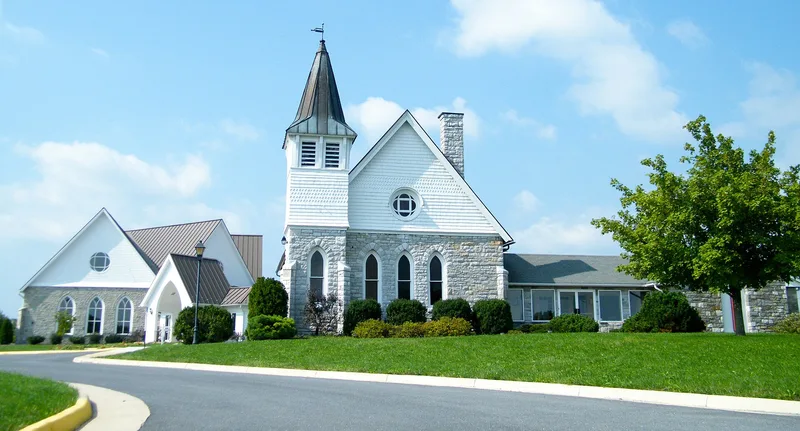
Opequon Presbyterian Church is a one-story random-rubble stone church near Winchester, completed in 1897 in the Gothic Revival style. It has Gothic-arched colored-glass windows, a three-stage northeast bell tower with the main entrance, circular tracery windows in the shingled gables, and a standing-seam metal roof. Inside, a molded-metal ceiling survives. A stone education building from 1956 is attached. The church is the third on its site; log meeting houses stood here from about 1736 and 1755, followed by a stone church in 1790 that was damaged in the Civil War and gutted by fire in 1873. Descendants of early settlers helped fund the 1897 rebuilding, partly using stones from the 1790 walls. Four burying grounds on the property include the oldest known marked grave in the Shenandoah Valley, that of John Wilson, who died in 1742. The congregation is regarded as one of the oldest west of the Blue Ridge.
Significance in brief: The nomination argues the property represents the religious and funerary practices of early Shenandoah Valley settlers and the growth of Presbyterianism there. Its cemeteries hold the oldest known marked grave in the Valley (Wilson, 1742), and the congregation, established about 1736, is among the oldest west of the Blue Ridge.
Machine-generated summary. This summary was generated by a language model from the official nomination document and has not been reviewed line by line by an editor. It may contain errors. Check the source document before relying on any detail. Source: nomination document (PDF) · National Archives catalog entry. NRHP reference 01000145, listed February 16, 2001. Summary generated October 2026 (model claude-sonnet-5-5, prompt v1.0-2026-10-29, confidence high).
Key facts
| Address | 217 Opequon Church Ln., Winchester |
|---|---|
| County | Frederick County |
| Listed | February 16, 2001 |
| Reference number | 01000145 |
| Resource type | Building |
| Period of significance | 1742-1897 |
| Architectural style | Late Victorian: Gothic Revival |
| Criteria |
|
| Areas of significance | Religion, Exploration/Settlement |
| Level of significance | Local |
| Status (as stated in the nomination) | Still used as a religious facility with active cemeteries; a 1956 education building connects to the sanctuary. |
| Acreage | 5.3 |
| Coordinates | 39.13892, -78.19496 (NPS GIS) |
What listing means for this property
Religious properties are listed for their architectural or historical significance, not their religious use. Listing is honorary and does not restrict the congregation's use of the building. The federal rehabilitation credit is generally unavailable unless part of the building is income-producing; some state programmes and preservation grants do cover religious buildings. Federal funding or permits trigger Section 106 review.
General information, not legal or tax advice. Rules change; confirm with your State Historic Preservation Office or a qualified adviser.
Sources and further reading
- National Park Service, National Register of Historic Places database (snapshot May 2026), reference 01000145.
- Nomination form (PDF, National Archives) — catalog entry
- Wikipedia article (used for cross-checking only; text not reproduced here)
- Wikidata Q14713031
- This listing as JSON
Last updated October 2026. Found an error? See the editorial policy for how to report it.