Belvoir Mansion Ruins and the Fairfax Grave
Also known as: Belvoir
Why it's listed
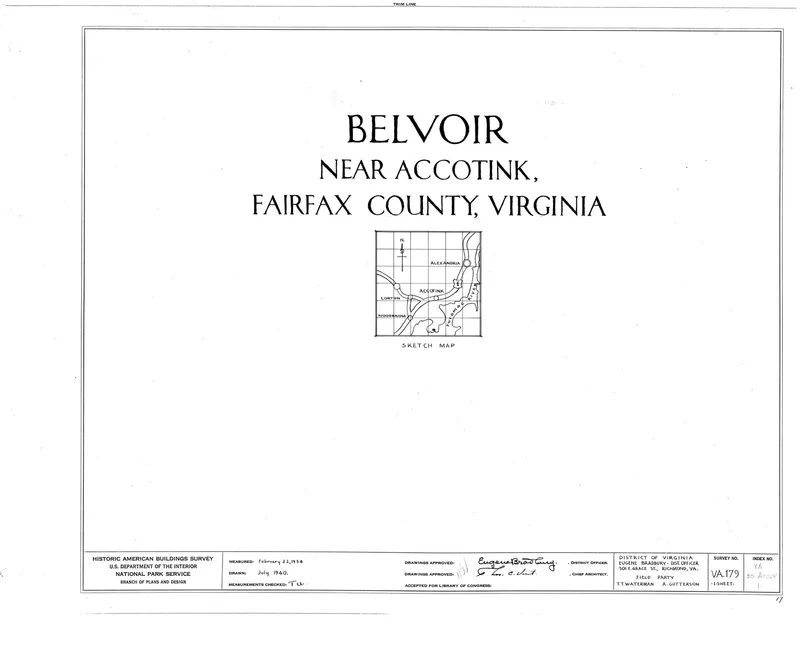
Belvoir was a brick plantation mansion on the Potomac River, built by Colonel William Fairfax between 1736 and 1741 and now preserved as ruins at Fort Belvoir in Fairfax County. Fairfax served as land agent for his cousin Lord Thomas Fairfax, Collector of Customs for the South Potomac, and President of the Virginia Council. The house was the family seat for thirty-two years and linked to George Washington, who began his surveying experience from Belvoir in 1748 and described it as one of the most beautiful estates on the river. It was rented after George William Fairfax left for England in 1773, burned in 1783, and was further damaged in the 1814 Battle of Belvoir. Excavation has exposed brick foundations and drains at the main house and three outbuildings. Nearby, a stone memorial within an iron fence marks the graves of William Fairfax and his wife, with inscriptions for two sons killed in colonial wars. Plans call for a public park.
Significance in brief: Belvoir was for decades the seat of one of Virginia's most distinguished families and was closely tied to George Washington, who visited it and wrote about it often. Marriages and friendships formed there connected the Fairfax, Washington and Carlyle families. The site also holds archaeological potential in its outbuildings, and the grave memorial marks William Fairfax, his wife and two sons.
Machine-generated summary. This summary was generated by a language model from the official nomination document and has not been reviewed line by line by an editor. It may contain errors. Check the source document before relying on any detail. Source: nomination document (PDF) · National Archives catalog entry. NRHP reference 73002337, listed June 4, 1973. Summary generated October 2026 (model claude-sonnet-5-5, prompt v1.0-2026-10-29, confidence medium).
Key facts
| Address | SE of intersection of 23rd St. and Belvoir Rd., Fort Belvoir |
|---|---|
| County | Fairfax (city and county) |
| Listed | June 4, 1973 |
| Reference number | 73002337 |
| Resource type | Site |
| Period of significance | 18th Century |
| Architect / builder | Colonel William Fairfax (builder) |
| Areas of significance | Historic - Non-Aboriginal |
| Level of significance | Local |
| Status (as stated in the nomination) | Site is under archeological excavation; brick foundations and drains exposed at the main house and three buildings. Plans call for a public park to protect the ruins. The grave site is in excellent condition. |
| Acreage | 10 |
| Coordinates | 38.67956, -77.12915 (NPS GIS) |
What listing means for this property
Sites (archaeological sites, battlefields, landscapes) are often listed with a restricted address to protect them from looting or disturbance. Listing is honorary for private owners; federal undertakings on or near the site go through Section 106 review, and state laws may protect burials and artefacts regardless of listing.
General information, not legal or tax advice. Rules change; confirm with your State Historic Preservation Office or a qualified adviser.
Sources and further reading
- National Park Service, National Register of Historic Places database (snapshot May 2026), reference 73002337.
- Nomination form (PDF, National Archives) — catalog entry
- Wikipedia article (used for cross-checking only; text not reproduced here)
- Wikidata Q816286
- This listing as JSON
Last updated October 2026. Found an error? See the editorial policy for how to report it.