Turner-LaRowe House
Turner-LaRowe House is a building in Charlottesville (Independent City), Charlottesville, Virginia, listed on the National Register of Historic Places on August 10, 1983 (reference number 83003275). The National Park Service records its significance in Architecture at the state level.
Facts from the NPS National Register database (); nomination summary October 2026. Last updated . Sources for each fact.

Approximate location: the National Park Service places this pin arbitrarily within the property, not at a surveyed point (stated accuracy ±12 m).
Why it's listed
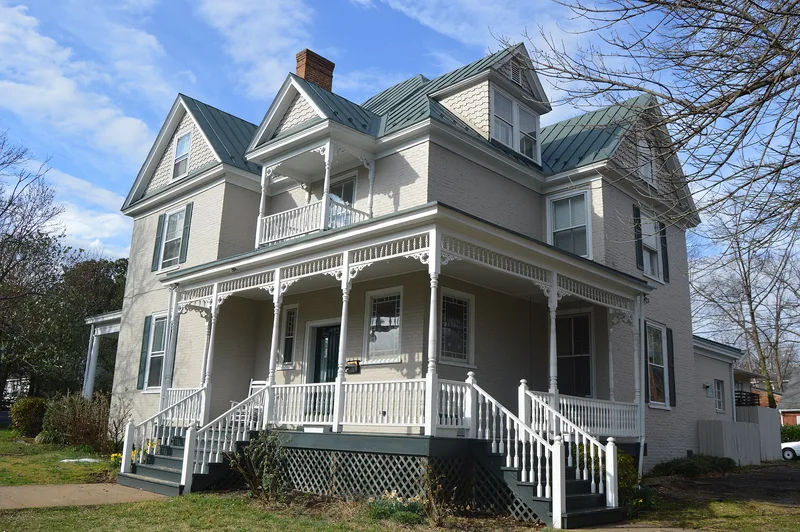
Built in 1892 for Mary P. Turner on land from her late husband's estate, this 2½-storey brick house sits at the corner of University Court and 15th Street in Charlottesville. It faces south toward the University of Virginia. The irregular plan has projecting bays, a high hip roof of standing-seam metal, pedimented dormers and gables, and two verandas, one with Eastlake posts and one with Tuscan columns. Leaded stained glass lights the main stair and several other windows, and every room has a fireplace with a Victorian mantel. From 1913 it was home to John S. LaRowe, a billiard parlor owner and the University's boxing coach, who trained national champions and Olympic contestants. It was later divided into apartments. The house was recognized as one of the city's earliest late Victorian buildings and one of the few that kept its original character without heavy alteration.
Significance in brief: The nomination presents the house as one of the first examples of late Victorian architecture in Charlottesville and one of the few Victorian houses in the city without extensive alteration. It is noted for its stained glass. It was also the home of Johnny LaRowe, a local billiard parlor owner and University of Virginia boxing coach. A reviewer's comments describe it as a local example of Queen Anne, Eastlake and Colonial Revival details.
Machine-generated summary. This summary was generated by a language model from the official nomination document and has not been reviewed line by line by an editor. It may contain errors. Check the source document before relying on any detail. Source: nomination document (PDF) · National Archives catalog entry. NRHP reference 83003275, listed August 10, 1983. Summary generated October 2026 (model claude-sonnet-5-5, prompt v1.0-2026-10-29, confidence medium).
Key facts
| Official database NPS National Register database, ref. 83003275 , checked | |
|---|---|
| Address | 1 University Court, Charlottesville (Independent City) |
| County | Charlottesville |
| Listed | August 10, 1983 |
| Reference number | 83003275 |
| Resource type | Building |
| Areas of significance | Architecture |
| Level of significance | State |
| National Historic Landmark | No |
| Acreage | 0.3 |
| Official document, machine-extracted Nomination form (National Archives) , checked | |
| Architectural style | Victorian (with Queen Anne, Eastlake and Colonial Revival details noted by the reviewer) |
| Criteria |
|
| Status (as stated in the nomination) | Survey records condition as fair in 1980. It was later divided into five apartments, and in one survey version was being rehabilitated as a sorority house. |
| Official dataset NPS cultural-resource GIS (NRHP locations) | |
| Coordinates | 38.03796, -78.49829 |
| Computed Computed from NPS GIS district boundaries | |
| Within district | Rugby Road-University Corner Historic District |
What listing means for this property
National Register listing is honorary for a privately owned home: it does not by itself restrict what an owner may do with their own money, and it does not require public access. Restrictions come from local landmark or historic-district ordinances, which are separate (how they differ).
Owner-occupied houses are not eligible for the 20% federal rehabilitation tax credit, which applies to income-producing buildings, but many states offer credits for homeowners. Listing also opens the door to preservation easements and to buying a plaque. Start with what listing means for homeowners, renovating a listed house and selling one.
General information, not legal or tax advice. Rules change; confirm with your State Historic Preservation Office or a qualified adviser.
Questions about Turner-LaRowe House
When was Turner-LaRowe House added to the National Register of Historic Places?
Turner-LaRowe House was listed on August 10, 1983. Its National Register reference number is 83003275.
Is Turner-LaRowe House a National Historic Landmark?
No. The National Park Service database (snapshot of May 2026) lists Turner-LaRowe House on the National Register but does not record it as a National Historic Landmark.
Where is Turner-LaRowe House?
1 University Court, Charlottesville (Independent City), Charlottesville, Virginia; coordinates 38.03796, -78.49829.
Why is Turner-LaRowe House historically significant?
According to a machine-generated summary of its nomination form: The nomination presents the house as one of the first examples of late Victorian architecture in Charlottesville and one of the few Victorian houses in the city without extensive alteration. It is noted for its stained glass. It was also the home of Johnny LaRowe, a local billiard parlor owner and University of Virginia boxing coach. A reviewer's comments describe it as a local example of Queen Anne, Eastlake and Colonial Revival details. Check the nomination document before relying on any detail.
Is Turner-LaRowe House in a historic district?
Yes. Its location falls within the Rugby Road-University Corner Historic District, itself listed on the National Register. (Computed from National Park Service boundary data; the district nomination's own list of contributing resources may differ.)
Where can I read the original nomination for Turner-LaRowe House?
The nomination form is a public record held by the National Archives: nomination document (PDF).
Sources and further reading
- National Park Service, National Register of Historic Places database (snapshot May 2026), reference 83003275.
- Nomination form (PDF, National Archives) — catalog entry
- Wikipedia article (used for cross-checking only; text not reproduced here)
- Wikidata Q16902125
- This listing as JSON
Last updated November 2026. Found an error? See the editorial policy for how to report it.