Rugby Road-University Corner Historic District

Why it's listed
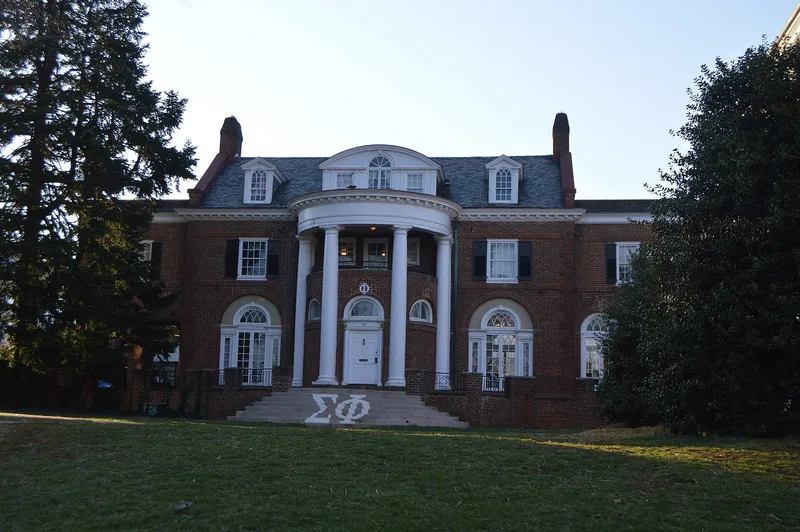
North of Thomas Jefferson's original academical village at the University of Virginia, this eighty-four-acre Charlottesville neighborhood grew alongside the university between the 1890s and the Great Depression. It centers on University Avenue and Rugby Road and falls into four segments: a commercial strip known as the Corner, the campus and Carr's Hill area, the University Circle residential enclave, and a grid of houses, apartments and fraternity houses. Of 221 major structures, 48 are noncontributing. About three-quarters of the buildings show revival styles, especially Colonial and Georgian Revival. Notable examples include Anderson's Bookstore with its three-story sheetmetal facade, St. Anthony's Hall of 1902, the first purpose-built fraternity house in the city, Fayerweather Hall, the president's residence designed by McKim, Mead and White, and Lambeth Field's concrete stadium with a Doric colonnade. Wyndhurst, probably from the late 1850s, is the oldest surviving dwelling. Tree-lined streets and open spaces add to the district's character.
Machine-generated summary. This summary was generated by a language model from the official nomination document and has not been reviewed line by line by an editor. It may contain errors. Check the source document before relying on any detail. Source: nomination document (PDF) · catalog entry. Generated October 2026 (model claude-sonnet-5-5, prompt v1.0-2026-10-29).
| Styles | Late 19th- and early 20th-century revival styles, chiefly Colonial and Georgian Revival, with Neo-classical, Queen Anne, Bungalow and Craftsman examples |
|---|---|
| Areas of significance | Commerce, Education, Architecture |
| Acreage | 84 |
| Boundary source | NPS cultural-resource GIS polygon |
| Full listing page | Rugby Road-University Corner Historic District (property record) |
What listing means for this property
This is a historic district. Buildings within its boundary are either contributing (they add to the district's significance) or non-contributing. Owners of contributing income-producing buildings can claim the 20% federal rehabilitation tax credit; homeowners should look at state credits. National Register districts impose no design review by themselves; a local historic district ordinance, if one exists, does (the difference explained).
General information, not legal or tax advice. Rules change; confirm with your State Historic Preservation Office or a qualified adviser.