Red Hill

Why it's listed
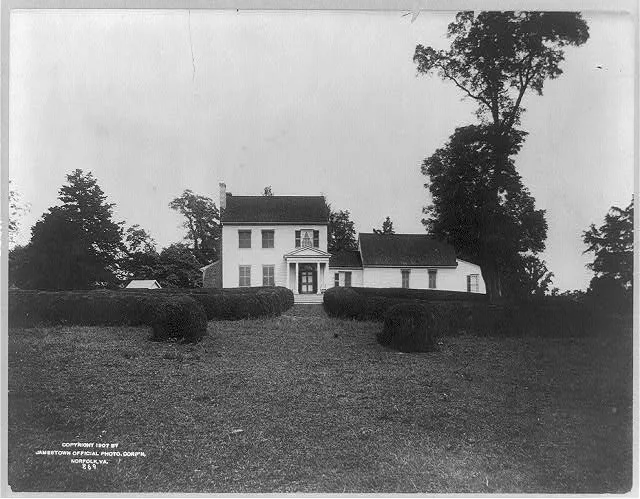
Red Hill, in Charlotte County near Brookneal, Virginia, was Patrick Henry's last home and is the place where he is buried. Henry assembled the plantation from several purchases of fertile bottom land and rolling countryside above the Staunton River. Two of his children were born there, and his wife Dorothea lived on the property for three decades after his death. The main house was enlarged in the antebellum period, renovated in the 1910s, and destroyed by fire in 1919. Henry's frame law office survived and is the principal original building. After a memorial foundation bought the estate, architect Stanhope Johnson supervised reconstruction of the house, kitchen, smokehouse, privies and slave quarters using earlier drawings, photographs and archaeological work. The graves of Henry and his wife lie in a walled enclosure nearby. The 117-acre site is open to the public as a memorial and gives a credible impression of an early Southside Virginia farmstead.
Significance in brief: The nomination argues Red Hill is the last home, burial place and permanent memorial of Patrick Henry, the Orator of the Revolution. His original law office survives, and the reconstructed house and outbuildings, based on research and earlier drawings, give a credible picture of an early Southside Virginia farmstead. The plantation is described as little changed in appearance from Henry's time.
Machine-generated summary. This summary was generated by a language model from the official nomination document and has not been reviewed line by line by an editor. It may contain errors. Check the source document before relying on any detail. Source: nomination document (PDF) · National Archives catalog entry. NRHP reference 78003012, listed February 14, 1978. Summary generated October 2026 (model claude-sonnet-5-5, prompt v1.0-2026-10-29, confidence medium).
Key facts
| Address | SE of Brookneal on SR 677, Brookneal |
|---|---|
| County | Charlotte County |
| Listed | February 14, 1978 |
| Reference number | 78003012 |
| Resource type | Building |
| Period of significance | 1700-1799, 1800-1899, 1900- |
| Architect / builder | Charles Barton Keen (architect), J. T. McLaughlin (contractor), Charles Welan (landscape architect) for the 1910-1912 renovation; Stanhope Johnson supervised later reconstruction |
| Areas of significance | Politics/Government, Agriculture |
| Level of significance | State |
| Status (as stated in the nomination) | Condition rated excellent and altered; maintained as a memorial and open to the public as a museum. |
| Acreage | 117.3 |
| Coordinates | 37.03068, -78.89493 (NPS GIS) |
What listing means for this property
National Register listing is honorary: it recognises significance and does not restrict what a private owner may do without federal money or permits. It unlocks the 20% federal rehabilitation tax credit for income-producing buildings, state credits in many states, and Section 106 review when federal agencies are involved. See what listing means in practice.
General information, not legal or tax advice. Rules change; confirm with your State Historic Preservation Office or a qualified adviser.
Sources and further reading
- National Park Service, National Register of Historic Places database (snapshot May 2026), reference 78003012.
- Nomination form (PDF, National Archives) — catalog entry
- Wikipedia article (used for cross-checking only; text not reproduced here)
- Wikidata Q7304280
- This listing as JSON
Last updated October 2026. Found an error? See the editorial policy for how to report it.