Charlotte Court House Historic District
Also known as: VDHR No. 185-23; See also:Charlotte Court House

Why it's listed
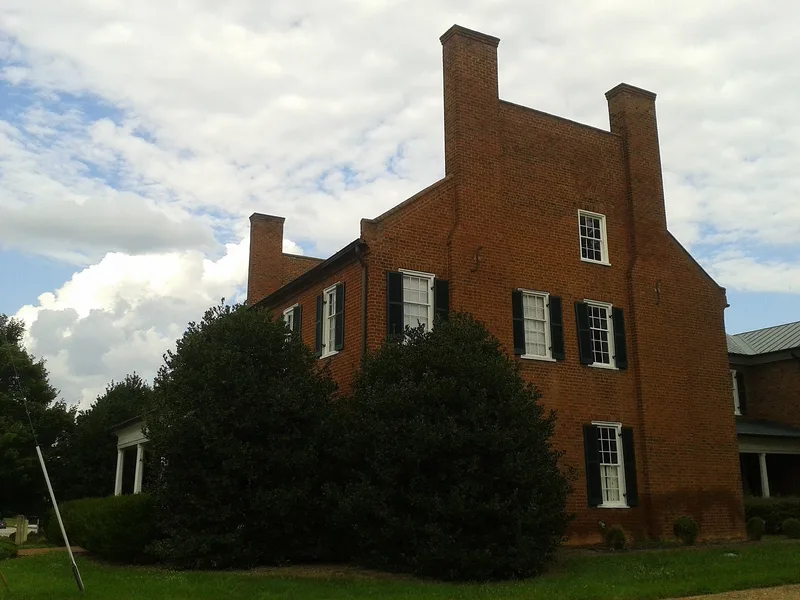
Charlotte Court House, the seat of Charlotte County in Virginia's southern Piedmont, was created by the colonial legislature in 1759 and named county seat in 1764. No eighteenth-century buildings survive, but the historic district preserves most of the town's streets and lots as mapped in 1817. Its focus is Courthouse Square, where the 1823 brick temple-form courthouse, built by John Percival from plans by Thomas Jefferson, stands among an 1840 clerk's office, a 1900 clerk's office, a Confederate monument and a 1936 jail. Nearby are a ca. 1820 Federal-style tavern, early brick and frame stores, a Masonic lodge, Greek Revival and Methodist churches, a library created from a Federal-style house, and two large farms, Wynyard and Villeview. Colonial Revival schools and 1930s government buildings add later layers. The district counts 53 contributing resources and ten noncontributing buildings, and it is regarded as one of Virginia's best preserved courthouse towns.
Significance in brief: The nomination presents the district as one of the best preserved courthouse towns in Virginia. Its centerpiece is the 1823 courthouse designed by Thomas Jefferson, set in a county government square that is among the best preserved in the state. The surrounding taverns, stores, churches, schools, farms and houses show the town's growth from the early nineteenth century into the 1940s.
Machine-generated summary. This summary was generated by a language model from the official nomination document and has not been reviewed line by line by an editor. It may contain errors. Check the source document before relying on any detail. Source: nomination document (PDF) · National Archives catalog entry. NRHP reference 95000023, listed February 8, 1995. Summary generated October 2026 (model claude-sonnet-5-5, prompt v1.0-2026-10-29, confidence medium).
Key facts
| Address | VA 40 between VA 645 and VA 47, Charlotte Court House |
|---|---|
| County | Charlotte County |
| Listed | February 8, 1995 |
| Reference number | 95000023 |
| Resource type | District |
| Architect / builder | Thomas Jefferson (courthouse plans); John Percival (local contractor who built the courthouse) |
| Architectural style | Early Classical Revival, Federal, Greek Revival, Gothic Revival, Queen Anne, Romanesque, Colonial Revival |
| Areas of significance | Politics/Government, Architecture |
| Level of significance | State |
| Status (as stated in the nomination) | Most buildings remain in use as government offices, law offices, churches, a library and dwellings. Two early-twentieth-century school buildings are described as vacant. |
| Acreage | 157 |
| Coordinates | 37.05906, -78.64414 (NPS GIS) |
What listing means for this property
This is a historic district. Buildings within its boundary are either contributing (they add to the district's significance) or non-contributing. Owners of contributing income-producing buildings can claim the 20% federal rehabilitation tax credit; homeowners should look at state credits. National Register districts impose no design review by themselves; a local historic district ordinance, if one exists, does (the difference explained).
General information, not legal or tax advice. Rules change; confirm with your State Historic Preservation Office or a qualified adviser.
Sources and further reading
- National Park Service, National Register of Historic Places database (snapshot May 2026), reference 95000023.
- Nomination form (PDF, National Archives) — catalog entry
- Wikipedia article (used for cross-checking only; text not reproduced here)
- Wikidata Q14712155
- This listing as JSON
Last updated October 2026. Found an error? See the editorial policy for how to report it.