Augusta Stone Church

Why it's listed
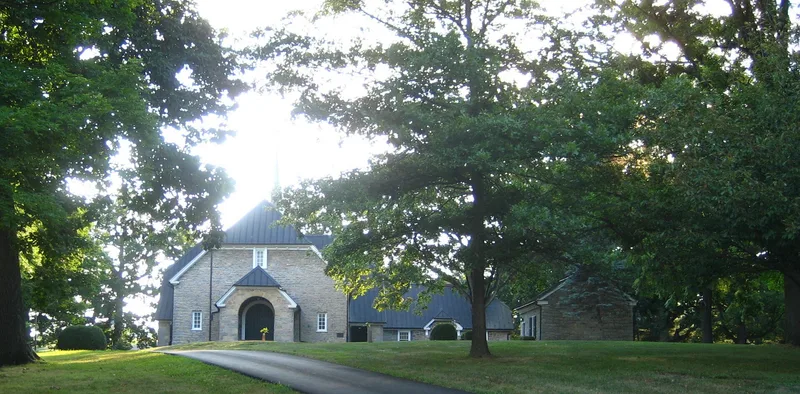
Augusta Stone Church sits in a grove of trees beside Route 11, the old Valley Pike, at Fort Defiance, about seven miles north of Staunton. Its limestone rubble walls, 20 inches thick, belong to the original meeting house, which measured 57 feet 2 inches by 39 feet and had a clipped gable roof. Pastor John Craig supervised construction, and on January 22, 1749, he recorded the congregation's first meeting and preaching in the new building. It replaced an earlier log meeting house probably built in 1740. The church was renovated in 1922 into a cruciform plan with a small spire, and a stone wing was added in 1956, but the original roof trusses remain. It is described as the oldest surviving church in the Valley of Virginia and the oldest Presbyterian church in continuous use in the state. The congregation also owns the largest set of colonial communion silver of any Virginia church.
Significance in brief: The nomination calls it the oldest surviving church in the Valley of Virginia and the oldest Presbyterian church in continuous use in Virginia. It is tied to pastor John Craig, the state's first regularly settled Presbyterian pastor. Its original form shows the simple rectangular plan of early Valley meeting houses, and it is one of only three surviving colonial church buildings in Virginia with clipped gables. It also owns the largest set of colonial communion silver of any Virginia church.
Machine-generated summary. This summary was generated by a language model from the official nomination document and has not been reviewed line by line by an editor. It may contain errors. Check the source document before relying on any detail. Source: nomination document (PDF) · National Archives catalog entry. NRHP reference 73001994, listed May 9, 1973. Summary generated October 2026 (model claude-sonnet-5-5, prompt v1.0-2026-10-29, confidence high).
Key facts
| Address | U.S. 11, Fort Defiance |
|---|---|
| County | Augusta County |
| Listed | May 9, 1973 |
| Reference number | 73001994 |
| Resource type | Building |
| Period of significance | 18th Century |
| Areas of significance | Architecture, Religion, Social History |
| Level of significance | State |
| Status (as stated in the nomination) | Occupied and in use as a church; the form describes the building as much enlarged and altered, with additions in 1922 and 1956. |
| Acreage | 30 |
| Coordinates | 38.23841, -78.97359 (NPS GIS) |
What listing means for this property
Religious properties are listed for their architectural or historical significance, not their religious use. Listing is honorary and does not restrict the congregation's use of the building. The federal rehabilitation credit is generally unavailable unless part of the building is income-producing; some state programmes and preservation grants do cover religious buildings. Federal funding or permits trigger Section 106 review.
General information, not legal or tax advice. Rules change; confirm with your State Historic Preservation Office or a qualified adviser.
Sources and further reading
- National Park Service, National Register of Historic Places database (snapshot May 2026), reference 73001994.
- Nomination form (PDF, National Archives) — catalog entry
- Wikipedia article (used for cross-checking only; text not reproduced here)
- Wikidata Q4820970
- This listing as JSON
Last updated October 2026. Found an error? See the editorial policy for how to report it.