Monticello

Why it's listed
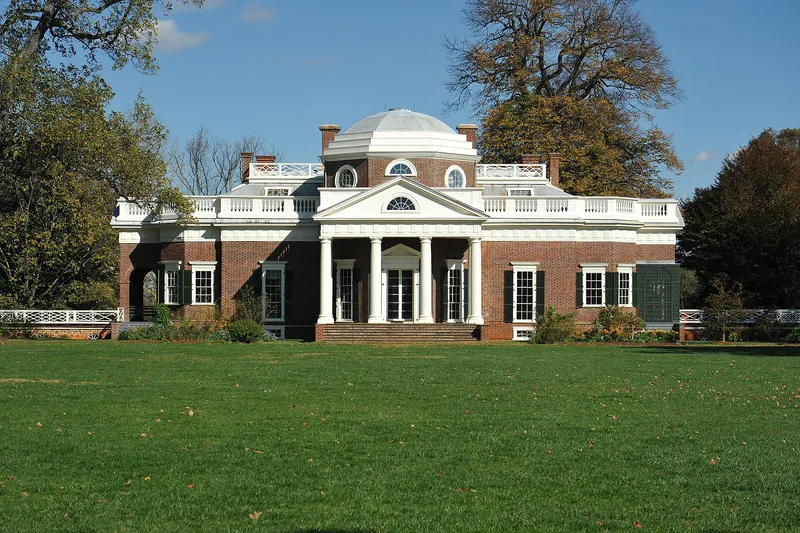
Monticello is the hilltop mansion and estate where Thomas Jefferson lived, worked and died in 1826, set on a leveled "little mountain" two miles southeast of Charlottesville, Virginia. Jefferson designed the red brick house himself, starting in 1770, and rebuilt and enlarged it between 1796 and 1809 in a more Roman manner influenced by his years in France. A low dome, Doric porticoes, a balustraded roofline and a formal plan with terraced passages and small pavilions give it a restrained, horizontal look. Inside, Jefferson's inventions include dumbwaiters, folding doors, a duplicate-writing machine and a weight-driven clock. The property matters because of its owner, who wrote the Declaration of Independence, served as third President, completed the Louisiana Purchase and founded the University of Virginia. It is also valued as an influential work of early American neoclassical architecture. Later owners restored it, and the Thomas Jefferson Memorial Foundation has held it since 1923 as a museum.
Significance in brief: It was the home of Thomas Jefferson, author of the Declaration of Independence and third President, who designed the entire complex, lived there during his most productive years and died there in 1826. The house is also cited as a leading example of Classic Revival design that influenced the Early Republican or Federal style.
Machine-generated summary. This summary was generated by a language model from the official nomination document and has not been reviewed line by line by an editor. It may contain errors. Check the source document before relying on any detail. Source: nomination document (PDF) · National Archives catalog entry. NRHP reference 66000826, listed October 15, 1966. Summary generated October 2026 (model claude-sonnet-5-5, prompt v1.0-2026-10-29, confidence medium).
Key facts
| Address | 2 mi. S of Charlottesville on VA 53, Charlottesville |
|---|---|
| County | Albemarle County |
| Listed | October 15, 1966 |
| Reference number | 66000826 |
| Resource type | Building |
| Period of significance | 1772-1826 |
| Architect / builder | Thomas Jefferson (designer) |
| Architectural style | Classic Revival; Early Republican/Federal influence |
| Areas of significance | Politics/Government |
| Level of significance | National |
| National Historic Landmark | Yes, designated December 19, 1960 |
| Status (as stated in the nomination) | Described as in excellent condition and unaltered on its original site; occupied and open to the public as a museum. |
| Acreage | 1676 |
| Within district | Southern Albemarle Rural Historic District |
| Coordinates | 38.00126, -78.43088 (NPS GIS) |
What listing means for this property
National Register listing is honorary: it recognises significance and does not restrict what a private owner may do without federal money or permits. It unlocks the 20% federal rehabilitation tax credit for income-producing buildings, state credits in many states, and Section 106 review when federal agencies are involved. See what listing means in practice.
General information, not legal or tax advice. Rules change; confirm with your State Historic Preservation Office or a qualified adviser.
Sources and further reading
- National Park Service, National Register of Historic Places database (snapshot May 2026), reference 66000826.
- Nomination form (PDF, National Archives) — catalog entry
- Wikipedia article (used for cross-checking only; text not reproduced here)
- Wikidata Q199618
- This listing as JSON
Last updated October 2026. Found an error? See the editorial policy for how to report it.