Piereus Store

Why it's listed
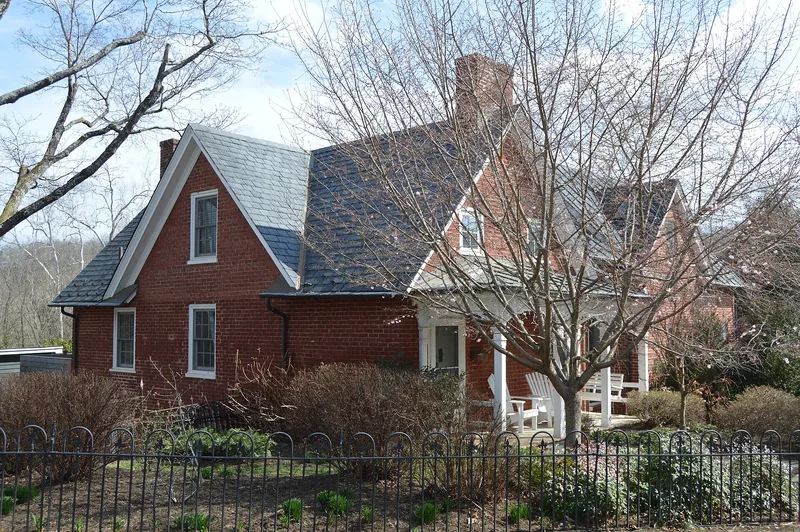
Built between about 1835 and 1840, this brick building at 1901 East Market Street in Charlottesville began as a store serving a growing industrial settlement on the Rivanna River. William Hunter Meriwether, an entrepreneur who bought the land in 1825, named the area "Pireus" as the port city of Charlottesville and built a toll bridge, mills and a cotton factory there. The store was probably meant to serve the factory's workers. The factory later developed into the Charlottesville Woolen Mills. The building is a rectangular, gable-front vernacular structure. Its facade is laid in Flemish bond, the other walls in American bond, and the roof, chimneys and Victorian porch appear to be later additions. After several owners, the property passed to the Woolen Mills in 1875 and became a residence. It is one of two houses surviving from the Pireus phase and recalls the self-contained mill community that once included a church, a school and workers' housing.
Significance in brief: The building is closely tied to the early industrial development that led to the Charlottesville Woolen Mills, the city's most important industry in the late 1800s. It is one of two houses remaining from the "Pireus" phase of development along the Rivanna. Reviewers accepted it because, although altered, it is significant for its association with the 19th-century growth of the Woolen Mills.
Machine-generated summary. This summary was generated by a language model from the official nomination document and has not been reviewed line by line by an editor. It may contain errors. Check the source document before relying on any detail. Source: nomination document (PDF) · National Archives catalog entry. NRHP reference 83003272, listed August 10, 1983. Summary generated October 2026 (model claude-sonnet-5-5, prompt v1.0-2026-10-29, confidence medium).
Key facts
| Address | 1901 E. Market St., Charlottesville (Independent City) |
|---|---|
| County | Charlottesville |
| Listed | August 10, 1983 |
| Reference number | 83003272 |
| Resource type | Building |
| Architectural style | No identifiable style; simple vernacular structure |
| Areas of significance | Industry |
| Level of significance | State |
| Status (as stated in the nomination) | Listed as in good condition; used as a single-family residence at the time of the survey. |
| Acreage | 0.4 |
| Coordinates | 38.02174, -78.45601 (NPS GIS) |
What listing means for this property
For an income-producing building, listing (individually or as a contributing building in a district) is the gateway to the 20% federal rehabilitation tax credit on qualified rehabilitation costs, often stackable with state credits. Work claiming the credit must follow the Secretary of the Interior's Standards and be approved in advance.
Listing does not restrict a private owner acting without federal money or permits; where federal funding or licensing is involved, Section 106 review applies.
General information, not legal or tax advice. Rules change; confirm with your State Historic Preservation Office or a qualified adviser.
Sources and further reading
- National Park Service, National Register of Historic Places database (snapshot May 2026), reference 83003272.
- Nomination form (PDF, National Archives) — catalog entry
- Wikipedia article (used for cross-checking only; text not reproduced here)
- Wikidata Q15266250
- This listing as JSON
Last updated October 2026. Found an error? See the editorial policy for how to report it.