Moore-Hancock Farmstead
Also known as: Site No. 41 TV 1405

Why it's listed
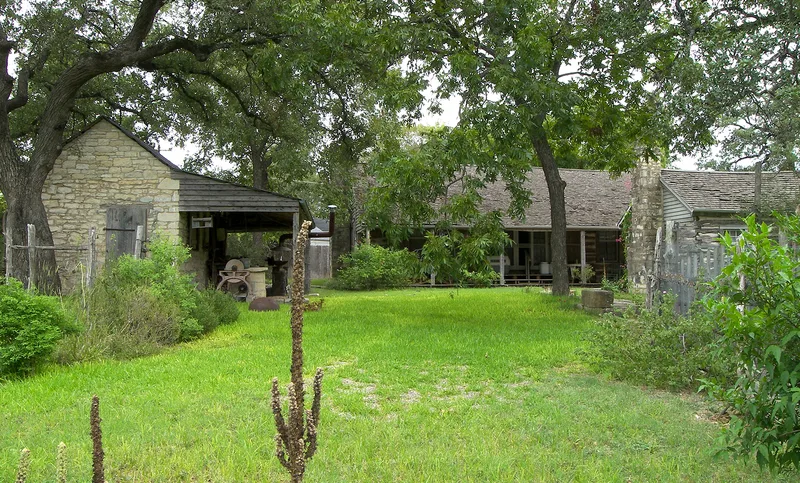
This farmstead in northwest Austin preserves a center-passage log house built about 1849 from locally obtained cedar and limestone. Two log pens flank an open dogtrot. A small log outbuilding, a stone kitchen with a root cellar cut into bedrock, and a hand-dug well complete the group. Martin Moore, who opened the first store in the new town of Austin, retired here to farm his wife Elizabeth's land. In 1866 the tract passed to John Hancock, a Texas Unionist politician and later congressman, whose nephews ran a dairy from the house. The dairy kept operating into the twentieth century, and the house was later altered, divided into apartments and condemned in 1987. A multi-year restoration guided by architectural study and archeology removed later additions and recovered the early appearance. It is considered the only surviving log dwelling in Austin on its original site, and excavations yielded some 700,000 artifacts about early settlement and farm life.
Significance in brief: The nomination calls it the only log dwelling in Austin known to survive on its original site. It was the rural home of Martin Moore, Austin's first merchant, and later the base for a dairy run by the family of Congressman John Hancock. It also holds archeological value, with more than 700,000 artifacts recovered during restoration.
Machine-generated summary. This summary was generated by a language model from the official nomination document and has not been reviewed line by line by an editor. It may contain errors. Check the source document before relying on any detail. Source: nomination document (PDF) · National Archives catalog entry. NRHP reference 94001079, listed September 2, 1994. Summary generated October 2026 (model claude-sonnet-5-5, prompt v1.0-2026-10-29, confidence high).
Key facts
| Address | 4811 Sinclair Ave., Austin |
|---|---|
| County | Travis County |
| Listed | September 2, 1994 |
| Reference number | 94001079 |
| Resource type | Building |
| Period of significance | 1849-1899 |
| Architect / builder | unknown |
| Architectural style | Other: center passage |
| Criteria |
|
| Areas of significance | Agriculture, Exploration/Settlement, Historic - Non-Aboriginal |
| Level of significance | Local |
| Status (as stated in the nomination) | Restored in the early 1990s to its 19th-century appearance; still used as a single-family dwelling. |
| Acreage | 0.9 |
| Coordinates | 30.32188, -97.74151 (NPS GIS) |
What listing means for this property
National Register listing is honorary for a privately owned home: it does not by itself restrict what an owner may do with their own money, and it does not require public access. Restrictions come from local landmark or historic-district ordinances, which are separate (how they differ).
Owner-occupied houses are not eligible for the 20% federal rehabilitation tax credit, which applies to income-producing buildings, but many states offer credits for homeowners. Listing also opens the door to preservation easements and to buying a plaque. Start with what listing means for homeowners, renovating a listed house and selling one.
General information, not legal or tax advice. Rules change; confirm with your State Historic Preservation Office or a qualified adviser.
Sources and further reading
- National Park Service, National Register of Historic Places database (snapshot May 2026), reference 94001079.
- Nomination form (PDF, National Archives) — catalog entry
- Wikidata Q110002377
- This listing as JSON
Last updated October 2026. Found an error? See the editorial policy for how to report it.