Hyde Park Historic District
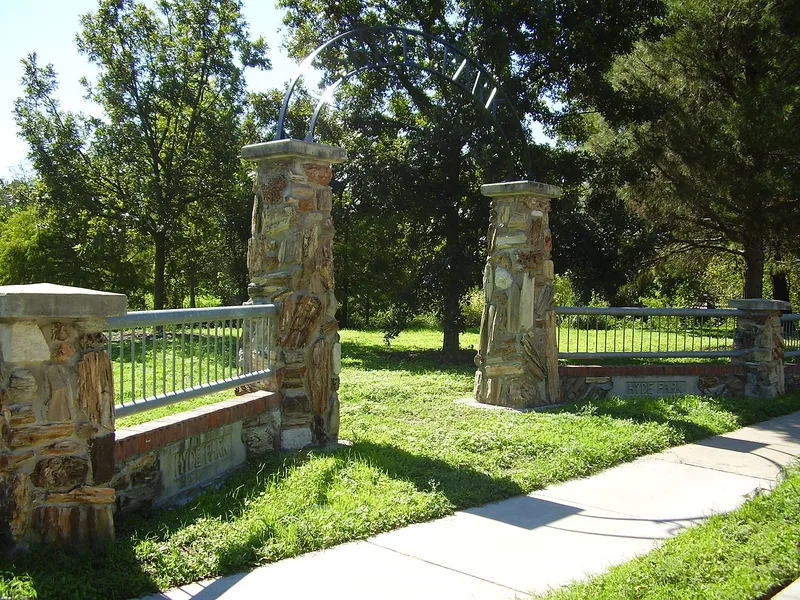

Why it's listed
Hyde Park is a 32-block neighborhood about 20 blocks north of Austin's original town site, laid out in 1891 as a residential suburb by Monroe M. Shipe and the Missouri, Kansas and Texas Land and Town Company. Promoted as "The Pride of Austin," it is described as the city's first streetcar suburb, closely tied to the electric streetcar line Shipe installed in 1890. Detached single-family houses on 50-by-120-foot lots define the area. Bungalows make up about 80 percent of the historic dwellings, most built in the 1920s and early 1930s. Victorian-era vernacular houses, some with Queen Anne detailing, account for about 15 percent, and a few Tudor Revival houses appear as well. Shipe Park, dedicated in 1928, is the largest open space. The district contains 273 contributing and 237 noncontributing resources, and about 90 percent of the historic structures were built by 1935. It was recognized for its architecture, with a period of significance from 1891 to 1941.
Significance in brief: The nomination argues the district is significant under Criterion C for architecture, with a largely intact collection of Bungalow-era houses (about 80%) and Victorian-era dwellings (about 15%). It also treats Hyde Park as Austin's first streetcar suburb, developed by Monroe M. Shipe, whose electric streetcar line shaped its early growth.
Machine-generated summary. This summary was generated by a language model from the official nomination document and has not been reviewed line by line by an editor. It may contain errors. Check the source document before relying on any detail. Source: nomination document (PDF) · National Archives catalog entry. NRHP reference 90001191, listed August 16, 1990. Summary generated October 2026 (model claude-sonnet-5-5, prompt v1.0-2026-10-29, confidence high).
Key facts
| Address | Roughly bounded by Ave. A, 45th St., Duval St., and 40th St., Austin |
|---|---|
| County | Travis County |
| Listed | August 16, 1990 |
| Reference number | 90001191 |
| Resource type | District |
| Period of significance | 1891-1941 |
| Architect / builder | unknown |
| Architectural style | Bungalow, Queen Anne, Tudor Revival |
| Criteria |
|
| Areas of significance | Architecture |
| Level of significance | Local |
| Status (as stated in the nomination) | Historic properties are described as well maintained, with most essentially unaltered and many recently restored or rehabilitated; use remains primarily single dwellings. |
| Acreage | 138.5 |
| Coordinates | 30.30865, -97.73002 (NPS GIS) |
What listing means for this property
This is a historic district. Buildings within its boundary are either contributing (they add to the district's significance) or non-contributing. Owners of contributing income-producing buildings can claim the 20% federal rehabilitation tax credit; homeowners should look at state credits. National Register districts impose no design review by themselves; a local historic district ordinance, if one exists, does (the difference explained).
General information, not legal or tax advice. Rules change; confirm with your State Historic Preservation Office or a qualified adviser.
Sources and further reading
- National Park Service, National Register of Historic Places database (snapshot May 2026), reference 90001191.
- Nomination form (PDF, National Archives) — catalog entry
- Wikipedia article (used for cross-checking only; text not reproduced here)
- Wikidata Q16892567
- This listing as JSON
Last updated October 2026. Found an error? See the editorial policy for how to report it.