Nacogdoches Downtown Historic District

The pin is a point inside the NPS boundary polygon, not a surveyed location.
Why it's listed
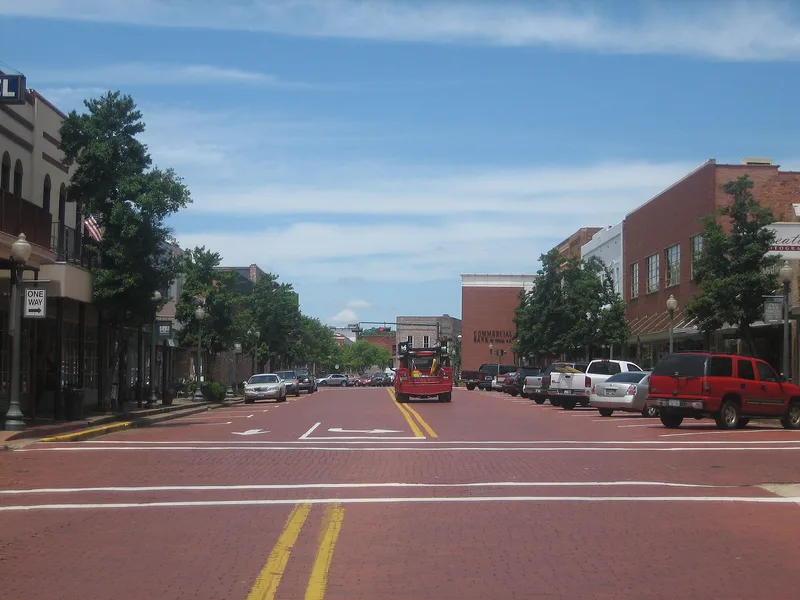
Downtown Nacogdoches, in east Texas about fifty miles from the Louisiana border, grew from an eighteenth-century Spanish military outpost on the El Camino Real. This district covers roughly nineteen blocks of the historic commercial core, arranged around the plaza principal and an irregular street grid inherited from the Spanish colonial era. It contains 134 resources, 94 of them contributing. Most are one- and two-part brick commercial buildings erected between 1890 and 1930, though the earliest building, the Durst-Taylor House, dates to 1835. Other resources include the 1917-18 Classical Revival post office and federal building, the Modernist Hotel Fredonia, a railroad depot, early gas stations and small concrete bridges. Architect Dietrich Rulfs brought a German brick-building tradition, while Creole influences also appear. Fires between 1903 and 1908 destroyed many buildings and led to a fire department. The district was recognized for its commercial development, architecture and planning, with a period of significance from 1835 to 1957.
Significance in brief: The nomination argues the district shows the economic, physical and architectural development of Nacogdoches from about 1779 onward. Its irregular street grid comes from Spanish colonial planning rather than a typical Texas courthouse square. Its buildings reflect Creole, German brick-building and common commercial styles, giving it an unusual character among Texas towns.
Machine-generated summary. This summary was generated by a language model from the official nomination document and has not been reviewed line by line by an editor. It may contain errors. Check the source document before relying on any detail. Source: nomination document (PDF) · National Archives catalog entry. NRHP reference 08000478, listed May 29, 2008. Summary generated October 2026 (model claude-sonnet-5-5, prompt v1.0-2026-10-29, confidence medium).
Key facts
| Address | Roughly bounded by Southern Pacific RR tracks, Banita Cr., Pilar, Mound, Arnold, North & Hospital Sts., Nacogdoches |
|---|---|
| County | Nacogdoches County |
| Listed | May 29, 2008 |
| Reference number | 08000478 |
| Resource type | District |
| Period of significance | 1835-1957 |
| Architect / builder | Dietrich Rulfs (architect, German-born, arrived 1889); James Wetmore (supervising architect, post office and federal building); Graeme McDonald Company (contractor, post office) |
| Architectural style | Classical Revival, Commercial, Moderne, International Style; One-part and Two-part Commercial Block |
| Areas of significance | Commerce, Architecture, Politics/Government |
| Level of significance | State |
| Status (as stated in the nomination) | Function list includes current commerce, government, hotel and religious uses; 94 contributing and 40 noncontributing resources. The form also lists vacant among current functions. |
| Acreage | 79 |
| Coordinates | 31.60557, -94.65513 (NPS GIS) |
What listing means for this property
This is a historic district. Buildings within its boundary are either contributing (they add to the district's significance) or non-contributing. Owners of contributing income-producing buildings can claim the 20% federal rehabilitation tax credit; homeowners should look at state credits. National Register districts impose no design review by themselves; a local historic district ordinance, if one exists, does (the difference explained).
General information, not legal or tax advice. Rules change; confirm with your State Historic Preservation Office or a qualified adviser.
Sources and further reading
- National Park Service, National Register of Historic Places database (snapshot May 2026), reference 08000478.
- Nomination form (PDF, National Archives) — catalog entry
- Wikidata Q107321674
- This listing as JSON
Last updated October 2026. Found an error? See the editorial policy for how to report it.