Rothko Chapel

Why it's listed
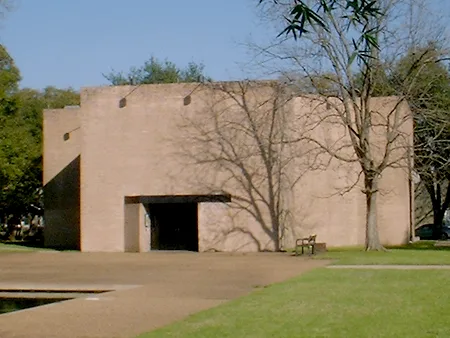
Rothko Chapel is a windowless, buff-rose brick building in Houston, Texas, completed in 1971 and laid out as an octagon inscribed in a Greek cross. Inside are 14 large paintings made by Mark Rothko specifically for the space, arranged in triptychs and single panels under a central skylight. Outside, a reflecting pool holds Barnett Newman's Cor-ten steel sculpture Broken Obelisk, dedicated to the memory of Martin Luther King Jr. The design passed from architect Philip Johnson to Howard Barnstone and Eugene Aubry after Johnson withdrew in 1967. Patrons Dominique and John de Menil commissioned the project, which began as a Catholic chapel for the University of St. Thomas and became a place for ecumenical exchange. It was listed because it is the only permanent installation made to Rothko's specifications, because it reflects the work of notable architects, and because of its link to the de Menils and to human rights and interfaith programs.
Significance in brief: The nomination argues the chapel is of exceptional national importance in Art as Mark Rothko's final work and the only permanent installation made to his specifications. It also qualifies in Architecture as a collaboration between Rothko and architects Philip Johnson, Howard Barnstone and Eugene Aubry. At the local level it is significant in Social History for its ties to patrons Dominique and John de Menil and its role in ecumenical dialogue and human rights advocacy.
Machine-generated summary. This summary was generated by a language model from the official nomination document and has not been reviewed line by line by an editor. It may contain errors. Check the source document before relying on any detail. Source: nomination document (PDF) · National Archives catalog entry. NRHP reference 00000883, listed August 16, 2000. Summary generated October 2026 (model claude-sonnet-5-5, prompt v1.0-2026-10-29, confidence high).
Key facts
| Address | 1409 Sul Ross Ave., Houston |
|---|---|
| County | Harris County |
| Listed | August 16, 2000 |
| Reference number | 00000883 |
| Resource type | Building |
| Period of significance | 1971 |
| Architect / builder | Johnson, Philip; Barnstone, Howard; Aubry, Eugene (architects); Lowry, E. G., Construction Company (builder); Rothko, Mark (painter) |
| Architectural style | Modern Movement/New Formalist |
| Criteria |
|
| Areas of significance | Art, Architecture, Social History |
| Level of significance | National, Local |
| Status (as stated in the nomination) | Largely unchanged since the early 1970s and described as retaining a high degree of integrity; still used as a cultural institution. |
| Acreage | 0.9 |
| Coordinates | 29.73769, -95.39628 (NPS GIS) |
What listing means for this property
Religious properties are listed for their architectural or historical significance, not their religious use. Listing is honorary and does not restrict the congregation's use of the building. The federal rehabilitation credit is generally unavailable unless part of the building is income-producing; some state programmes and preservation grants do cover religious buildings. Federal funding or permits trigger Section 106 review.
General information, not legal or tax advice. Rules change; confirm with your State Historic Preservation Office or a qualified adviser.
Sources and further reading
- National Park Service, National Register of Historic Places database (snapshot May 2026), reference 00000883.
- Nomination form (PDF, National Archives) — catalog entry
- Wikipedia article (used for cross-checking only; text not reproduced here)
- Wikidata Q2956755
- This listing as JSON
Last updated October 2026. Found an error? See the editorial policy for how to report it.