Freedmen's Town Historic District
Also known as: Fourth Ward
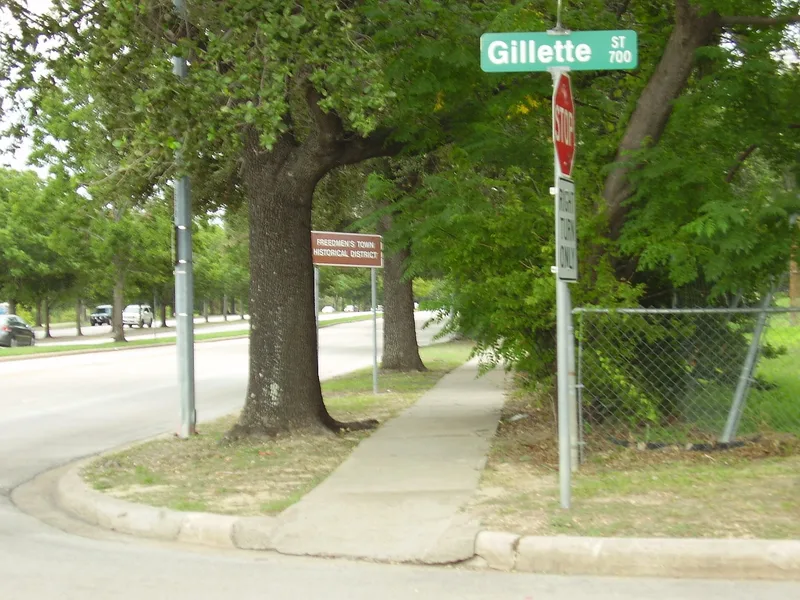

Why it's listed
Freedmen's Town, also called the Fourth Ward, is a district of roughly 567 buildings on forty blocks just west of downtown Houston. It grew from a settlement founded soon after Emancipation near Buffalo Bayou. Most surviving buildings went up between about 1890 and 1935 as low- and medium-cost housing for Black residents. One- and two-story frame shotgun houses, duplexes, tenements and earlier T- and L-plan cottages sit close together along narrow streets, many with porches and jig-cut ornament. Much of the housing was rental, built by small developers, and buildings were often moved, enlarged or reused. Churches such as Good Hope Missionary Baptist, a Gothic Revival design of 1929-30 by Black architect J. J. Hawkins, and Gregory Elementary School anchored community life. Public housing, freeway construction and downtown expansion in the mid-twentieth century erased much of the wider neighborhood. The remaining district is still largely intact, with 530 buildings counted as contributing, though demolitions and vacant lots threaten it.
Significance in brief: The district is the surviving core of Freedmen's Town, a community founded shortly after Emancipation on the west side of Houston. It retains densely packed frame housing, churches and a school that show how a Black urban community grew and consolidated in the early twentieth century. Of the 567 buildings, 530 (93%) are counted as contributing.
Machine-generated summary. This summary was generated by a language model from the official nomination document and has not been reviewed line by line by an editor. It may contain errors. Check the source document before relying on any detail. Source: nomination document (PDF) · National Archives catalog entry. NRHP reference 85000186, listed January 17, 1985. Summary generated October 2026 (model claude-sonnet-5-5, prompt v1.0-2026-10-29, confidence medium).
Key facts
| Address | Roughly Bounded by Genesse, West Dallas, Arthur and W. Gray Sts., Houston |
|---|---|
| County | Harris County |
| Listed | January 17, 1985 |
| Reference number | 85000186 |
| Resource type | District |
| Architect / builder | J. J. Hawkins (Black architect, Good Hope Missionary Baptist Church) |
| Architectural style | Predominantly vernacular frame housing (shotgun houses, T- and L-plan cottages, duplexes, tenements, bungalows); Gothic Revival church |
| Areas of significance | Commerce, Black, Architecture |
| Level of significance | State |
| Status (as stated in the nomination) | Mostly occupied residential area. Some buildings are deteriorated or abandoned, and nearly 60 buildings were demolished in the last decade before the nomination. |
| Acreage | 64 |
| Coordinates | 29.75548, -95.38037 (NPS GIS) |
What listing means for this property
This is a historic district. Buildings within its boundary are either contributing (they add to the district's significance) or non-contributing. Owners of contributing income-producing buildings can claim the 20% federal rehabilitation tax credit; homeowners should look at state credits. National Register districts impose no design review by themselves; a local historic district ordinance, if one exists, does (the difference explained).
General information, not legal or tax advice. Rules change; confirm with your State Historic Preservation Office or a qualified adviser.
Sources and further reading
- National Park Service, National Register of Historic Places database (snapshot May 2026), reference 85000186.
- Nomination form (PDF, National Archives) — catalog entry
- Wikidata Q109999719
- This listing as JSON
Last updated October 2026. Found an error? See the editorial policy for how to report it.