DePelchin Faith Home

Why it's listed
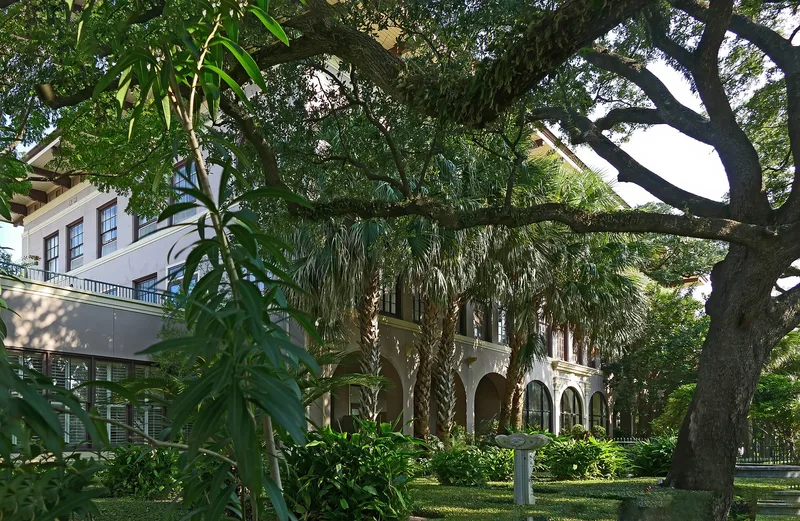
Built in 1912-1913 at 2700 Albany Street in Houston, this three-story red brick building, finished in white stucco, was designed as an orphanage and resembles an oversized Mediterranean villa. Its red barrel-tile hipped roof, broad overhanging eaves, ground-floor arcaded loggia and rows of round-arched windows give it a distinctive profile. The upper floors held large dormitories with sleeping porches across the front. The home was named in memory of Kezia Payne DePelchin, a Houston social work pioneer who cared for orphaned and disadvantaged children before her death in 1893. Houston women organized the home in her honor, and Harriett Levy donated the lots for this larger building. The St. Louis firm Mauran and Russell, also responsible for the Rice Hotel, designed it. It is considered the oldest surviving children's home in Houston and served as an orphanage until 1938. Later it housed the Rams Club, and restoration began around 1980.
Significance in brief: It is described as the oldest extant children's home in Houston, built through the efforts of prominent Houstonians and named in memory of social work pioneer Kezia Payne DePelchin. It is also a significant small-scale work by Mauran and Russell, a firm more often known for monumental Houston buildings, and an unusual building type preserved in relatively unaltered condition.
Machine-generated summary. This summary was generated by a language model from the official nomination document and has not been reviewed line by line by an editor. It may contain errors. Check the source document before relying on any detail. Source: nomination document (PDF) · National Archives catalog entry. NRHP reference 84001759, listed August 9, 1984. Summary generated October 2026 (model claude-sonnet-5-5, prompt v1.0-2026-10-29, confidence high).
Key facts
| Address | 2700 Albany St., Houston |
|---|---|
| County | Harris County |
| Listed | August 9, 1984 |
| Reference number | 84001759 |
| Resource type | Building |
| Period of significance | 1900- (specific dates 1912-1913) |
| Architect / builder | Mauran and Russell |
| Architectural style | Mediterranean villa |
| Areas of significance | Architecture, Social History |
| Level of significance | Local |
| Status (as stated in the nomination) | No longer serves as an orphanage; in the 1980s it was used as a club (bar) while restoration work was in progress. |
| Acreage | 0.9 |
| Coordinates | 29.74912, -95.38280 (NPS GIS) |
What listing means for this property
National Register listing is honorary for a privately owned home: it does not by itself restrict what an owner may do with their own money, and it does not require public access. Restrictions come from local landmark or historic-district ordinances, which are separate (how they differ).
Owner-occupied houses are not eligible for the 20% federal rehabilitation tax credit, which applies to income-producing buildings, but many states offer credits for homeowners. Listing also opens the door to preservation easements and to buying a plaque. Start with what listing means for homeowners, renovating a listed house and selling one.
General information, not legal or tax advice. Rules change; confirm with your State Historic Preservation Office or a qualified adviser.
Sources and further reading
- National Park Service, National Register of Historic Places database (snapshot May 2026), reference 84001759.
- Nomination form (PDF, National Archives) — catalog entry
- Wikidata Q110000963
- This listing as JSON
Last updated October 2026. Found an error? See the editorial policy for how to report it.