Courtlandt Place Historic District
Also known as: See Also:79002953; 79002955; 79002956; 79002958; 79002959; 790029

Why it's listed
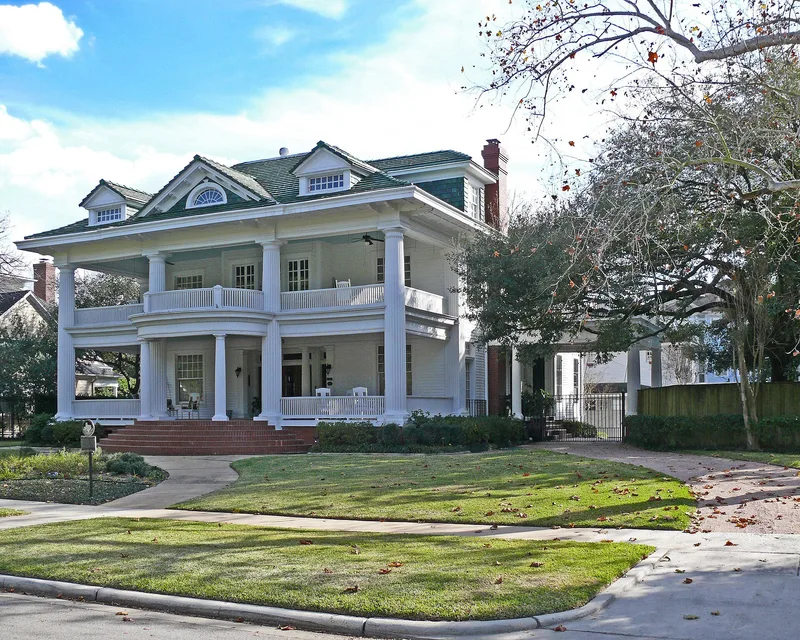
Courtlandt Place is a single boulevard in Houston, laid out in 1906 as an exclusive residential neighborhood. Eighteen houses were built along its tree-lined, divided street between 1911 and 1937, and they show Neo-Classical, Mediterranean, Tudor, Georgian and Colonial Revival designs, along with Prairie and Cotswold influences. Architects included Sanguinet & Staats, Alfred Finn, Birdsall Briscoe and John Staub. A single house from 1977-78 was added and was judged compatible with the older buildings. The district matters for its architecture and for its unusual continuity. Six restrictive covenants, set in perpetuity and enforced by the Courtlandt Association, barred commercial buildings and set minimum standards for houses, setbacks, fences and hedges. This kept the street residential while nearby areas filled with businesses. It makes Courtlandt Place the oldest Houston subdivision with its deed restrictions still in force. Early residents included lumbermen, lawyers, bankers, cotton brokers and oil executives, among them members of the Carter, Cleveland and Autry families.
Significance in brief: The nomination argues the street keeps its early 20th century character, with excellent examples of period architectural styles designed by well-known architects. It is one of the few intact old Houston subdivisions, and its deed restrictions have been enforced continuously, making it the oldest Houston subdivision with restrictions still in force. It was also home to prominent Houston business and civic leaders.
Machine-generated summary. This summary was generated by a language model from the official nomination document and has not been reviewed line by line by an editor. It may contain errors. Check the source document before relying on any detail. Source: nomination document (PDF) · National Archives catalog entry. NRHP reference 80004129, listed December 3, 1980. Summary generated October 2026 (model claude-sonnet-5-5, prompt v1.0-2026-10-29, confidence medium).
Key facts
| Address | 2--25 Courtlandt Pl., Houston |
|---|---|
| County | Harris County |
| Listed | December 3, 1980 |
| Reference number | 80004129 |
| Resource type | District |
| Architect / builder | Sanguinet & Staats; Sanguinet, Staats & Barnes; Sanguinet, Staats & Gottlieb; Alfred Finn; Birdsall P. Briscoe; Warren & Wetmore; John Staub; Carlos B. Schoeppl; Olle J. Lorehn |
| Architectural style | Neo-Classical Revival, Mediterranean Revival, Tudor Revival, Georgian Revival, Colonial Revival, Prairie Style, Cotswold |
| Areas of significance | Community Planning and Development, Architecture |
| Level of significance | Local |
| Status (as stated in the nomination) | Condition marked excellent and altered; occupied, in private residential use. The 1969 freeway extension destroyed the original east entrance, which was re-landscaped in 1974 using salvaged stones and fencing. |
| Acreage | 13 |
| Within district | Westmoreland Historic District |
| Coordinates | 29.74271, -95.38327 (NPS GIS) |
What listing means for this property
This is a historic district. Buildings within its boundary are either contributing (they add to the district's significance) or non-contributing. Owners of contributing income-producing buildings can claim the 20% federal rehabilitation tax credit; homeowners should look at state credits. National Register districts impose no design review by themselves; a local historic district ordinance, if one exists, does (the difference explained).
General information, not legal or tax advice. Rules change; confirm with your State Historic Preservation Office or a qualified adviser.
Sources and further reading
- National Park Service, National Register of Historic Places database (snapshot May 2026), reference 80004129.
- Nomination form (PDF, National Archives) — catalog entry
- Wikipedia article (used for cross-checking only; text not reproduced here)
- Wikidata Q43082958
- This listing as JSON
Last updated October 2026. Found an error? See the editorial policy for how to report it.