Fredericksburg Historic District

Why it's listed
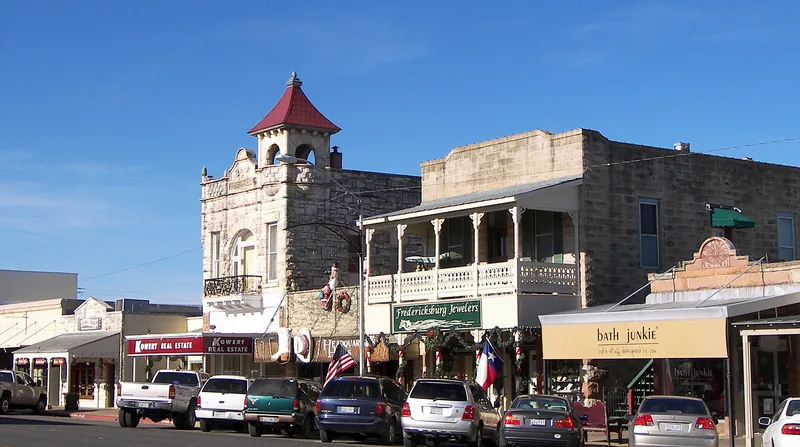
Fredericksburg's historic district covers about twelve blocks of a Texas Hill Country town founded in 1846 by German settlers sent by the Adelsverein. Most surviving nineteenth-century buildings are of local limestone, laid as ashlar or rubble, with some fachwerk timber-frame construction. The typical house is a story-and-a-half with a front porch and rear ell, set close to the street. Sunday houses, small town residences kept by country farmers for weekend marketing and church, are a distinctive local type. Notable buildings include the Kammlah House, now a museum, the Tatsch House with its thirteen-foot kitchen fireplace, the 1888 White Elephant Saloon, the St. Mary's church complex and the 1930s reconstruction of the octagonal Vereins-Kirche, originally built in 1846. The district was listed for its architecture and its German community, whose language and customs persist in the town.
Significance in brief: The district is nominated as a well-preserved example of a German settlement in the Texas Hill Country, with limestone and fachwerk buildings, Sunday houses and the reconstructed Vereins-Kirche. Its significance is tied to architecture and to the German ethnic community, and to the Adelsverein's colonization effort.
Machine-generated summary. This summary was generated by a language model from the official nomination document and has not been reviewed line by line by an editor. It may contain errors. Check the source document before relying on any detail. Source: nomination document (PDF) · National Archives catalog entry. NRHP reference 70000749, listed October 14, 1970. Summary generated October 2026 (model claude-sonnet-5-5, prompt v1.0-2026-10-29, confidence medium).
Key facts
| Address | Roughly bunded by Elk, Schubert, Acorn, and Creek Sts., Fredericksburg |
|---|---|
| County | Gillespie County |
| Listed | October 14, 1970 |
| Reference number | 70000749 |
| Resource type | District |
| Period of significance | 19th Century |
| Architect / builder | Lee Kiehne (reconstructed Vereins-Kirche); Leo M. J. Dielmann (St. Mary's Church and School); Edward Stein (1939 courthouse); John W. Kleck (White Elephant Saloon) |
| Architectural style | German vernacular (fachwerk and limestone masonry), with Gothic Revival and Classical Revival elements |
| Areas of significance | Art, European, Exploration/Settlement, Architecture |
| Level of significance | State |
| Status (as stated in the nomination) | Condition marked good and altered; the district has mixed commercial, residential, religious, museum and government uses, and preservation work is in progress. |
| Acreage | 304 |
| Coordinates | 30.27643, -98.87423 (NPS GIS) |
What listing means for this property
This is a historic district. Buildings within its boundary are either contributing (they add to the district's significance) or non-contributing. Owners of contributing income-producing buildings can claim the 20% federal rehabilitation tax credit; homeowners should look at state credits. National Register districts impose no design review by themselves; a local historic district ordinance, if one exists, does (the difference explained).
General information, not legal or tax advice. Rules change; confirm with your State Historic Preservation Office or a qualified adviser.
Sources and further reading
- National Park Service, National Register of Historic Places database (snapshot May 2026), reference 70000749.
- Nomination form (PDF, National Archives) — catalog entry
- Wikipedia article (used for cross-checking only; text not reproduced here)
- Wikidata Q5499198
- This listing as JSON
Last updated October 2026. Found an error? See the editorial policy for how to report it.