Stanard-Tilton Flour Mill
Also known as: Russell--Miller Milling Company; American Beauty Mill

Why it's listed
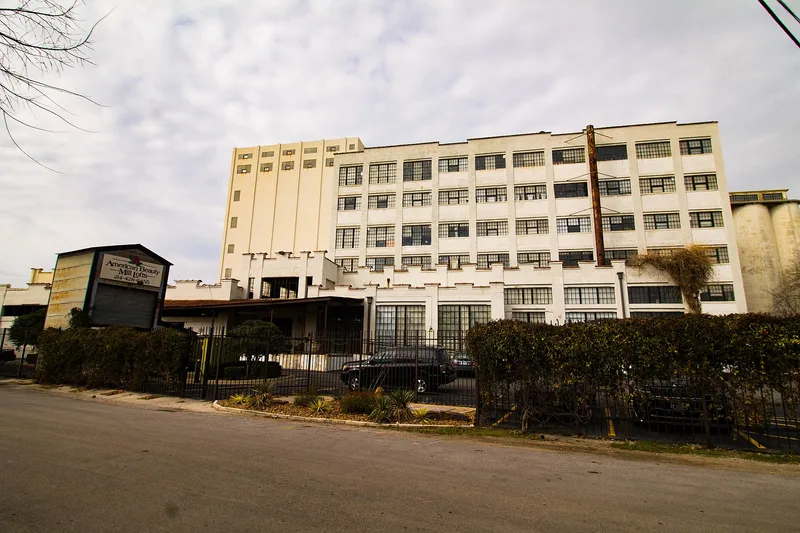
Rising six and seven stories beside the rail lines in south Dallas, this flour mill complex was built in 1912-13 by the Stanard-Tilton Milling Company of St. Louis after a 1908 Trinity River flood destroyed its earlier plant. The site offered rail access and safety from floodwaters. Reinforced concrete, brick and industrial steel sash define the buildings, which include a mill, warehouse, office, boiler room, grain silos and head house. Russell-Miller Milling Company of Minneapolis bought the operation in 1941 and expanded it in 1948, adding a corn milling facility and raising daily capacity to 8,500 hundredweight, about 20 percent of the state's milling capacity. The mill became the largest in its region and employed about 180 men when it closed in 1974. It is recognized locally for its role in Dallas industry and as a typical vertical grain-processing plant, one of only two such properties surviving in the city. It is now vacant.
Significance in brief: The mill is argued to be significant locally under Criterion A for Industry, as the largest flour milling operation in Dallas during its period of significance, built during the city's industrial redevelopment after the 1908 Trinity River flood. Under Criterion C it is significant in Architecture as a typical massive industrial mill complex, with vertical construction shaped by gravity-fed milling. It is one of only two such properties surviving in Dallas.
Machine-generated summary. This summary was generated by a language model from the official nomination document and has not been reviewed line by line by an editor. It may contain errors. Check the source document before relying on any detail. Source: nomination document (PDF) · National Archives catalog entry. NRHP reference 97001187, listed October 6, 1997. Summary generated October 2026 (model claude-sonnet-5-5, prompt v1.0-2026-10-29, confidence high).
Key facts
| Address | 2400 S. Ervay St., Dallas |
|---|---|
| County | Dallas County |
| Listed | October 6, 1997 |
| Reference number | 97001187 |
| Resource type | Building |
| Period of significance | 1912-48 |
| Architectural style | No Style |
| Criteria |
|
| Areas of significance | Industry, Architecture |
| Level of significance | Local |
| Status (as stated in the nomination) | Listed as vacant/not in use; the mill closed in 1974, and plans called for conversion to housing as a tax-incentive rehabilitation project. |
| Acreage | 2.1 |
| Coordinates | 32.76673, -96.78213 (NPS GIS) |
What listing means for this property
For an income-producing building, listing (individually or as a contributing building in a district) is the gateway to the 20% federal rehabilitation tax credit on qualified rehabilitation costs, often stackable with state credits. Work claiming the credit must follow the Secretary of the Interior's Standards and be approved in advance.
Listing does not restrict a private owner acting without federal money or permits; where federal funding or licensing is involved, Section 106 review applies.
Noted as vacant in the nomination. Nomination documents can be decades old; current status may differ. If you are considering buying an empty listed property, read the due-diligence checklist.
General information, not legal or tax advice. Rules change; confirm with your State Historic Preservation Office or a qualified adviser.
Sources and further reading
- National Park Service, National Register of Historic Places database (snapshot May 2026), reference 97001187.
- Nomination form (PDF, National Archives) — catalog entry
- Wikidata Q110000937
- This listing as JSON
Last updated October 2026. Found an error? See the editorial policy for how to report it.