North Bishop Avenue Commercial Historic District

Why it's listed
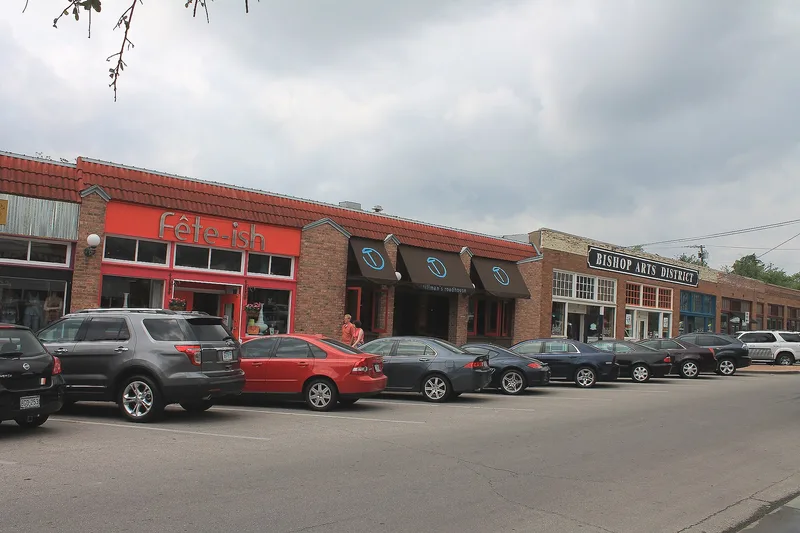
Along a short stretch of North Bishop Avenue in the Oak Cliff area of Dallas, a cluster of brick storefronts and two bungalows forms a compact commercial district of about 12 acres. It holds 15 contributing and five noncontributing buildings, most built in the mid-1920s, with dates ranging from 1915 to 1935. The buildings are mainly vernacular one- and two-part commercial blocks with geometric brick corbelling and decorative parapets, and two Tudor Revival examples at 313-21 and 400-08 North Bishop. The district grew from a streetcar stop at Davis Street and North Bishop Avenue, which drew merchants into what had been a residential subdivision. Shops there served nearby residents and included drugstores, garages, a movie theater and a bakery. The two surviving houses show the domestic fabric that commercial growth replaced. The district was recognized for its architecture, its integrity and its role as an example of streetcar-era commercial development, with a period of significance of 1915 to 1944.
Significance in brief: The district is significant at the local level under Criterion C for its excellent collection of 1920s and 1930s commercial architecture. It represents commercial nodes that arose within formerly residential Oak Cliff areas under pressure from busy streetcar stops and intersections. It retains a high degree of architectural integrity.
Machine-generated summary. This summary was generated by a language model from the official nomination document and has not been reviewed line by line by an editor. It may contain errors. Check the source document before relying on any detail. Source: nomination document (PDF) · National Archives catalog entry. NRHP reference 94000608, listed June 17, 1994. Summary generated October 2026 (model claude-sonnet-5-5, prompt v1.0-2026-10-29, confidence high).
Key facts
| Address | Roughly bounded by 9th St., Davis St., Adams and Madison, Dallas |
|---|---|
| County | Dallas County |
| Listed | June 17, 1994 |
| Reference number | 94000608 |
| Resource type | District |
| Period of significance | 1915-1944 |
| Architectural style | Other: one-part commercial block (with Tudor Revival and Classical Revival details on some buildings) |
| Criteria |
|
| Areas of significance | Architecture |
| Level of significance | Local |
| Status (as stated in the nomination) | Historic and current functions are listed as specialty store commerce and single dwelling; the two former houses have been converted to commercial use and several storefronts have been sympathetically rehabilitated. |
| Acreage | 12 |
| Coordinates | 32.74772, -96.82805 (NPS GIS) |
What listing means for this property
This is a historic district. Buildings within its boundary are either contributing (they add to the district's significance) or non-contributing. Owners of contributing income-producing buildings can claim the 20% federal rehabilitation tax credit; homeowners should look at state credits. National Register districts impose no design review by themselves; a local historic district ordinance, if one exists, does (the difference explained).
General information, not legal or tax advice. Rules change; confirm with your State Historic Preservation Office or a qualified adviser.
Sources and further reading
- National Park Service, National Register of Historic Places database (snapshot May 2026), reference 94000608.
- Nomination form (PDF, National Archives) — catalog entry
- Wikipedia article (used for cross-checking only; text not reproduced here)
- Wikidata Q7054198
- This listing as JSON
Last updated October 2026. Found an error? See the editorial policy for how to report it.