Lake Cliff Historic District

Why it's listed
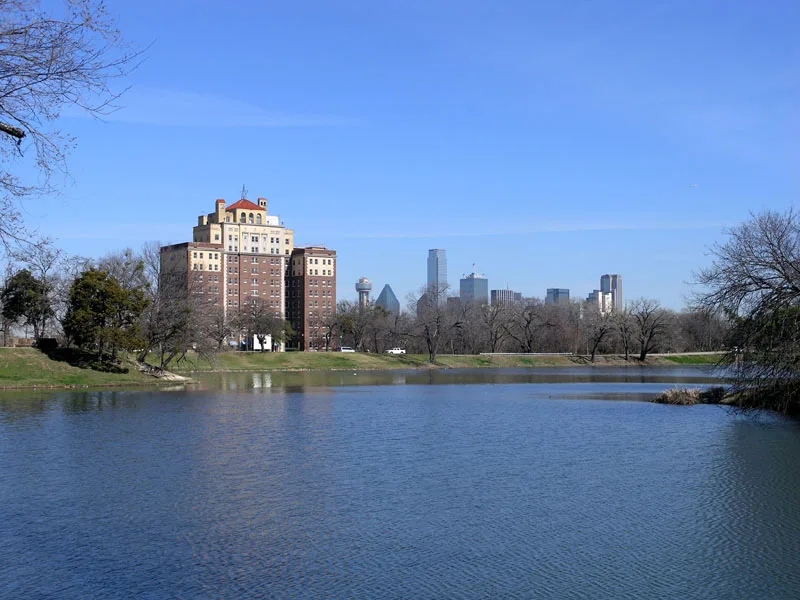
Lake Cliff Historic District occupies about 75 acres of flat, elevated ground in northeastern Oak Cliff, overlooking downtown Dallas. Its focus is Lake Cliff Park, built around a man-made lake excavated c. 1888 by a social club. The park later became a popular amusement park promoted by developers to draw settlers and raise land values, with rides, a skating rink and a casino hosting well-known performers. The city bought the land in 1913, and the park was redeveloped as a naturalistic space, with 1930s WPA stone shelters and pavilions. Houses and small apartment buildings from the 1920s and 1930s, mostly bungalows and four-squares with Craftsman, Prairie School or Tudor Revival details, were built facing the park. At the north edge stands the 13-story Mediterranean-style Cliff Towers Hotel, completed in 1932. Of 62 resources, 51 contribute to the district's character, which reflects the suburban marketing of Oak Cliff between 1888 and 1944.
Significance in brief: The district reflects the promotional and suburban development schemes used to attract residents to Oak Cliff, and the park's evolution from an amusement park into a naturalistic public park. It also holds an excellent collection of 1920s and 1930s single- and multi-family dwellings that typify Oak Cliff's growth.
Machine-generated summary. This summary was generated by a language model from the official nomination document and has not been reviewed line by line by an editor. It may contain errors. Check the source document before relying on any detail. Source: nomination document (PDF) · National Archives catalog entry. NRHP reference 94000609, listed June 17, 1994. Summary generated October 2026 (model claude-sonnet-5-5, prompt v1.0-2026-10-29, confidence high).
Key facts
| Address | Roughly bounded by E. 6th St., Beckley Ave., Zangs Blvd. and Marsalis Ave., Dallas |
|---|---|
| County | Dallas County |
| Listed | June 17, 1994 |
| Reference number | 94000609 |
| Resource type | District |
| Period of significance | 1888-1944 |
| Architect / builder | Hecht, Albert S.; Williams, Robert C. (architects); Bellows Maclay (contractor) |
| Architectural style | Bungalow, Prairie School, Tudor Revival, Mission/Spanish Colonial Revival (Mediterranean), Four-square, Rustic |
| Criteria |
|
| Areas of significance | Community Planning and Development, Architecture |
| Level of significance | Local |
| Status (as stated in the nomination) | Current functions are single and multiple dwellings and park; the former Cliff Towers Hotel is now a nursing home. The amusement park's bathing pool and bath house were demolished. |
| Acreage | 75 |
| Coordinates | 32.75706, -96.82072 (NPS GIS) |
What listing means for this property
This is a historic district. Buildings within its boundary are either contributing (they add to the district's significance) or non-contributing. Owners of contributing income-producing buildings can claim the 20% federal rehabilitation tax credit; homeowners should look at state credits. National Register districts impose no design review by themselves; a local historic district ordinance, if one exists, does (the difference explained).
General information, not legal or tax advice. Rules change; confirm with your State Historic Preservation Office or a qualified adviser.
Sources and further reading
- National Park Service, National Register of Historic Places database (snapshot May 2026), reference 94000609.
- Nomination form (PDF, National Archives) — catalog entry
- Wikipedia article (used for cross-checking only; text not reproduced here)
- Wikidata Q6475413
- This listing as JSON
Last updated October 2026. Found an error? See the editorial policy for how to report it.