Miraflores Park
Also known as: Miraflores Alumni Park

Why it's listed
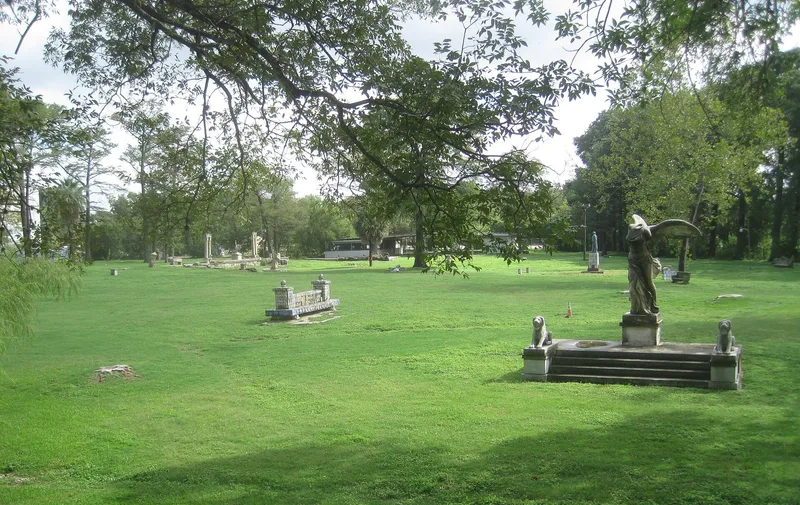
Miraflores Park is a 4.5-acre garden on Hildebrand Avenue in San Antonio, along the east bank of the San Antonio River. It is all that remains of a private park created in the 1920s for Dr. Aureliano Urrutia, a surgeon who left Mexico during the 1910 revolution. The grounds hold about 30 sculptures and garden objects, including tile-covered benches, urns, statues of Mexican historical figures, a small guest house called Quinta Maria built in 1923, and several concrete works by Dionicio Rodriguez. Rodriguez's pieces imitate wood and rock: a hollow-tree gate, a fallen-tree bench, a log stairway, a palapa-roofed bench and a stalactite grotto. Canals, pools and a large fountain once tied the garden together, but only their structures survive. The garden is considered significant as an early twentieth-century sculpture garden and as a showcase for Rodriguez's art and landscape design.
Significance in brief: It is nominated under Criterion C, in the areas of Art and Landscape Architecture, as an early 20th century sculpture garden. It holds several original faux bois concrete works by Dionicio Rodriguez, whose projects for Dr. Urrutia are believed to be his first work after arriving in San Antonio. It also reflects Urrutia's eclectic collecting of Mexican-themed statuary, tile benches and water features.
Machine-generated summary. This summary was generated by a language model from the official nomination document and has not been reviewed line by line by an editor. It may contain errors. Check the source document before relying on any detail. Source: nomination document (PDF) · National Archives catalog entry. NRHP reference 04001176, listed June 14, 2006. Summary generated October 2026 (model claude-sonnet-5-5, prompt v1.0-2026-10-29, confidence medium).
Key facts
| Address | 800 Hildebrand, San Antonio |
|---|---|
| County | Bexar County |
| Listed | June 14, 2006 |
| Reference number | 04001176 |
| Resource type | District |
| Period of significance | c.1926 |
| Architect / builder | Dionicio Rodriguez |
| Architectural style | Other: Faux Bois Sculpture |
| Criteria |
|
| Areas of significance | Art, Landscape Architecture |
| Level of significance | Local |
| Status (as stated in the nomination) | Many pieces need restoration, but the Rodriguez work is mostly in good condition. The tower, the faux rock fountain (demolished 2002) and the original water features are gone. The property is currently used as a park and for sculpture. |
| Acreage | 4.5 |
| Within district | Brackenridge Park |
| Coordinates | 29.46679, -98.46785 (NPS GIS) |
What listing means for this property
This is a historic district. Buildings within its boundary are either contributing (they add to the district's significance) or non-contributing. Owners of contributing income-producing buildings can claim the 20% federal rehabilitation tax credit; homeowners should look at state credits. National Register districts impose no design review by themselves; a local historic district ordinance, if one exists, does (the difference explained).
General information, not legal or tax advice. Rules change; confirm with your State Historic Preservation Office or a qualified adviser.
Sources and further reading
- National Park Service, National Register of Historic Places database (snapshot May 2026), reference 04001176.
- Nomination form (PDF, National Archives) — catalog entry
- Wikipedia article (used for cross-checking only; text not reproduced here)
- Wikidata Q109999887
- This listing as JSON
Last updated October 2026. Found an error? See the editorial policy for how to report it.