Kingston House
Also known as: Johnston House

Why it's listed
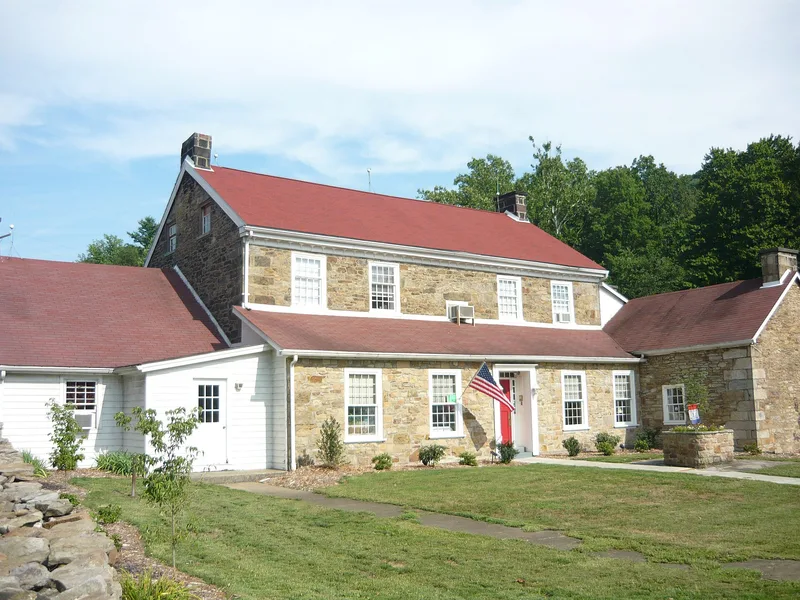
Built around 1815 for Alexander Johnston on Loyalhanna Creek near Latrobe, Kingston House is a five-bay, 2½-story rubble stone house with a central hall, one-story wings, and wood entablatures with brackets and fluted cornice details. Johnston, a Scots-Irish immigrant who had bought the Kingston tract in 1811, operated an early iron business there before turning the house into an inn. For roughly forty years it fed and lodged wagoneers, settlers and travelers on the road from Philadelphia to Pittsburgh, and it served as a regular stagecoach stop in the 1840s. Guests reportedly included William Henry Harrison and Zachary Taylor during their campaigns. The house is also tied to the Johnston family. Johnston's son William Freame Johnston served as Pennsylvania's governor from 1848 and was the first Whig to hold the office. The house is regarded as an unusually fine early example of a western Pennsylvania home.
Significance in brief: The nomination argues the house is significant for its role in early transportation and commerce as a long-running inn and stagecoach stop on a major east-west road, and for its association with the Johnston family, including Governor William Freame Johnston. It is also presented as a fine example of an early western Pennsylvania home, with unusual size and quality for its period and region.
Machine-generated summary. This summary was generated by a language model from the official nomination document and has not been reviewed line by line by an editor. It may contain errors. Check the source document before relying on any detail. Source: nomination document (PDF) · National Archives catalog entry. NRHP reference 83002286, listed June 30, 1983. Summary generated October 2026 (model claude-haiku-5-5, prompt v1.1-2026-10-29, confidence medium).
Key facts
| Address | U.S. 30, Youngstown |
|---|---|
| County | Westmoreland County |
| Listed | June 30, 1983 |
| Reference number | 83002286 |
| Resource type | Building |
| Period of significance | c.1815 |
| Architectural style | Federal vernacular |
| Areas of significance | Transportation, Politics/Government, Architecture |
| Level of significance | State |
| Status (as stated in the nomination) | Described as essentially unaltered from its original appearance, apart from an 1830 masonry wing and enclosed rear galleries. |
| Acreage | 1.4 |
| Coordinates | 40.29120, -79.34118 (NPS GIS) |
What listing means for this property
National Register listing is honorary for a privately owned home: it does not by itself restrict what an owner may do with their own money, and it does not require public access. Restrictions come from local landmark or historic-district ordinances, which are separate (how they differ).
Owner-occupied houses are not eligible for the 20% federal rehabilitation tax credit, which applies to income-producing buildings, but many states offer credits for homeowners. Listing also opens the door to preservation easements and to buying a plaque. Start with what listing means for homeowners, renovating a listed house and selling one.
General information, not legal or tax advice. Rules change; confirm with your State Historic Preservation Office or a qualified adviser.
Sources and further reading
- National Park Service, National Register of Historic Places database (snapshot May 2026), reference 83002286.
- Nomination form (PDF, National Archives) — catalog entry
- Wikipedia article (used for cross-checking only; text not reproduced here)
- Wikidata Q6413547
- This listing as JSON
Last updated October 2026. Found an error? See the editorial policy for how to report it.