Tacony Music Hall

Why it's listed
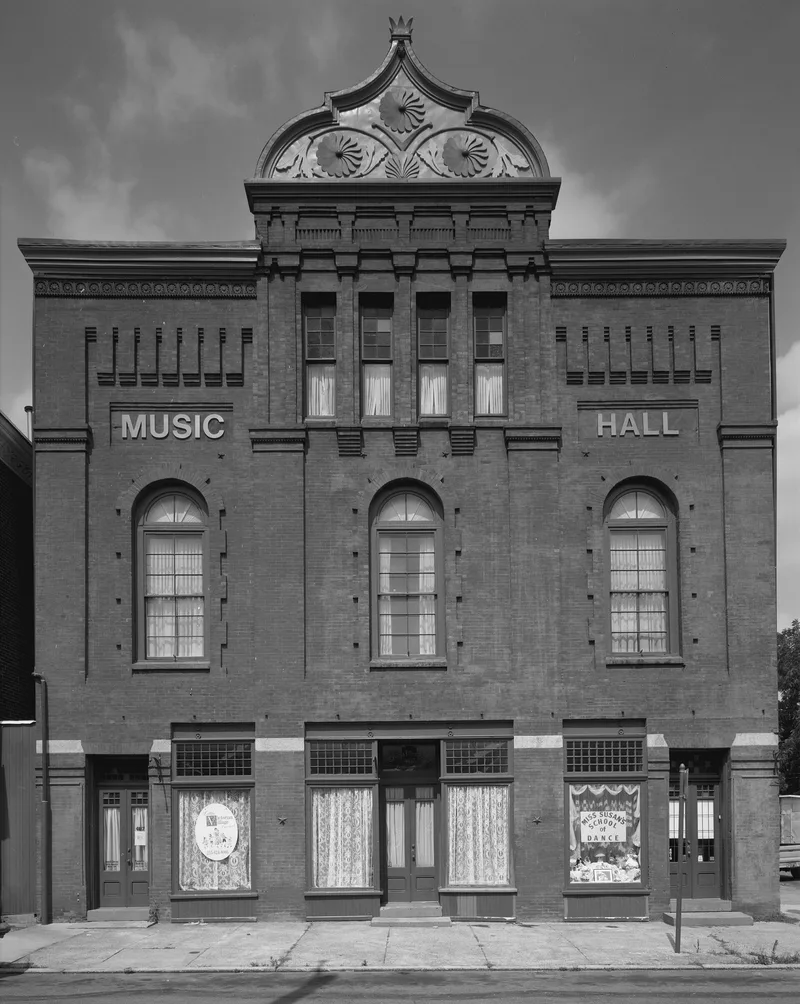
Built in 1885 by Frank W. Jordan, a druggist and speculator, the three-story brick block in Tacony, Philadelphia, combined rental shops on its ground floor, a second-floor music hall and third-floor library rooms. The second floor held an auditorium used for musical revues, variety shows, lectures and club meetings, and it became the community's cultural and social centre. The Keystone Association, later renamed the Disston Library and Free Reading Room, occupied the upper story, and Henry Disston's family provided financial support. Performers recorded at the hall included P.T. Barnum and Susan B. Anthony. The library moved out in 1906, and the hall declined as motion pictures grew in popularity. The building is listed for its association with the social and recreational life of a company town, with its features largely intact, including the metal-ceilinged auditorium and the committee room.
Significance in brief: The nomination argues the building documents the social history of Tacony, the industrial settlement Henry Disston laid out around his saw works. Its music hall served as the cultural, social and recreational center of the community and as meeting space for local clubs and lodges. The building also housed the Disston Library and Free Reading Room, which reflected the Disston family's paternalist social outlook.
Machine-generated summary. This summary was generated by a language model from the official nomination document and has not been reviewed line by line by an editor. It may contain errors. Check the source document before relying on any detail. Source: nomination document (PDF) · National Archives catalog entry. NRHP reference 90000413, listed March 9, 1990. Summary generated October 2026 (model claude-haiku-5-5, prompt v1.1-2026-10-29, confidence medium).
Key facts
| Address | 4815--19 Longshore Ave., Philadelphia |
|---|---|
| County | Philadelphia |
| Listed | March 9, 1990 |
| Reference number | 90000413 |
| Resource type | Building |
| Period of significance | 1885-1906 |
| Architectural style | Late Victorian; Romanesque |
| Criteria |
|
| Areas of significance | Entertainment/Recreation, Social History |
| Level of significance | Local |
| Status (as stated in the nomination) | The building is being rehabilitated under the federal historic preservation tax credit; the stage has been demolished and the building was converted to a furniture warehouse by World War Two. |
| Acreage | 0.1 |
| Within district | Tacony Disston Community Development Historic District |
| Coordinates | 40.02455, -75.04204 (NPS GIS) |
What listing means for this property
National Register listing is honorary for a privately owned home: it does not by itself restrict what an owner may do with their own money, and it does not require public access. Restrictions come from local landmark or historic-district ordinances, which are separate (how they differ).
Owner-occupied houses are not eligible for the 20% federal rehabilitation tax credit, which applies to income-producing buildings, but many states offer credits for homeowners. Listing also opens the door to preservation easements and to buying a plaque. Start with what listing means for homeowners, renovating a listed house and selling one.
General information, not legal or tax advice. Rules change; confirm with your State Historic Preservation Office or a qualified adviser.
Sources and further reading
- National Park Service, National Register of Historic Places database (snapshot May 2026), reference 90000413.
- Nomination form (PDF, National Archives) — catalog entry
- Wikipedia article (used for cross-checking only; text not reproduced here)
- Wikidata Q7674054
- This listing as JSON
Last updated October 2026. Found an error? See the editorial policy for how to report it.