North Broad Street Mansion District

Why it's listed
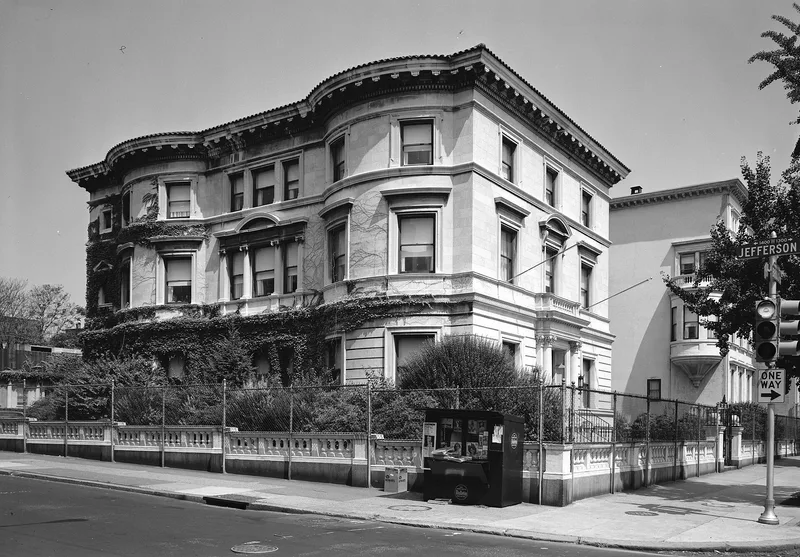
North Broad Street and the adjoining 1400 and 1500 blocks of North 15th and 16th Streets were built up after the streetcar lines reached the area in the 1870s and 1880s. The district holds mansions, townhouses, clubs and churches erected for industrialists, merchants and professionals who made their fortunes after the Civil War. The mansion at 1530 North 16th Street, designed by John MacArthur, Jr., for Edward H. Ogden, is a Second Empire house with a marble facade, and its interior retains decorative ceiling paintings and trompe l'oeil work. The Charles Ellis Residence of 1890 by William Decker has an asymmetrical brownstone facade and a multi-story central stair hall. Many Broad Street mansions were lost to commercial and academic development, but the core of the district survives on largely intact streetscapes. Its significance lies in showing how an affluent industrial class built and lived in this parallel-to-Broad layout around the turn of the century.
Significance in brief: The nomination argues the district preserves the opulent residential and institutional character of a nouveau riche industrialist community that developed parallel to Broad Street. It contains several of the city's most notable Victorian mansions, notably the Ogden House and the Ellis House, whose interiors are described as largely intact. It is presented as one of the few surviving remnants of this era in Philadelphia.
Machine-generated summary. This summary was generated by a language model from the official nomination document and has not been reviewed line by line by an editor. It may contain errors. Check the source document before relying on any detail. Source: nomination document (PDF) · National Archives catalog entry. NRHP reference 85000674, listed March 29, 1985. Summary generated October 2026 (model claude-haiku-5-5, prompt v1.1-2026-10-29, confidence medium).
Key facts
| Address | Roughly bounded by Broad, Jefferson, Willington, and Oxford Sts., Philadelphia |
|---|---|
| County | Philadelphia |
| Listed | March 29, 1985 |
| Reference number | 85000674 |
| Resource type | District |
| Period of significance | 1870-1907 |
| Architectural style | Second Empire, Italianate, Victorian Gothic, Queen Anne, Richardsonian Romanesque, Renaissance Revival, Colonial Revival |
| Criteria |
|
| Areas of significance | Architecture |
| Level of significance | Local |
| Status (as stated in the nomination) | Many Broad Street houses have been demolished, and the core of the district remains intact with most of the great houses and several clubs surviving. |
| Acreage | 15 |
| Within district | Lower North Philadelphia Speculative Housing Historic District |
| Coordinates | 39.97705, -75.16062 (NPS GIS) |
What listing means for this property
This is a historic district. Buildings within its boundary are either contributing (they add to the district's significance) or non-contributing. Owners of contributing income-producing buildings can claim the 20% federal rehabilitation tax credit; homeowners should look at state credits. National Register districts impose no design review by themselves; a local historic district ordinance, if one exists, does (the difference explained).
General information, not legal or tax advice. Rules change; confirm with your State Historic Preservation Office or a qualified adviser.
Sources and further reading
- National Park Service, National Register of Historic Places database (snapshot May 2026), reference 85000674.
- Nomination form (PDF, National Archives) — catalog entry
- Wikipedia article (used for cross-checking only; text not reproduced here)
- Wikidata Q7054297
- This listing as JSON
Last updated October 2026. Found an error? See the editorial policy for how to report it.