Fetter's Mill
Also known as: Ewald, Louis, Studio--Residence

Why it's listed
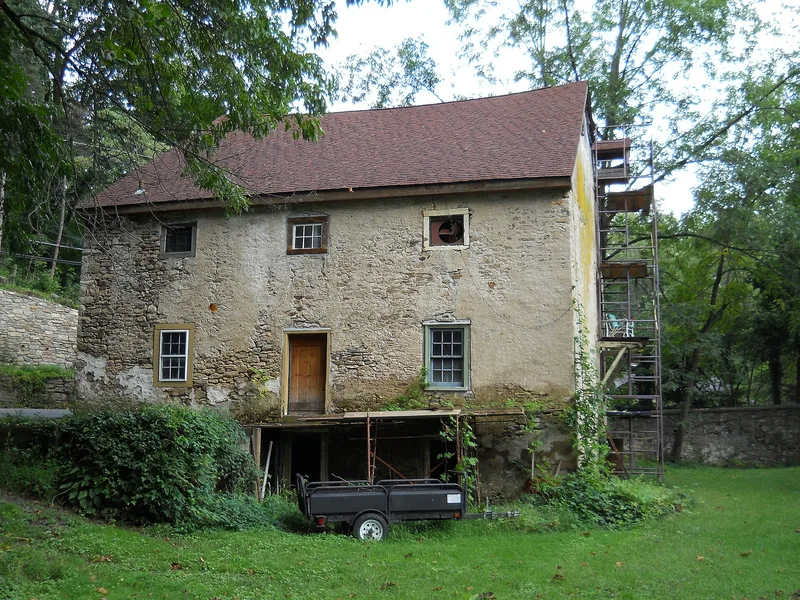
Built around the 1740s beside Pennypack Creek in Lower Moreland Township, Montgomery County, Pennsylvania, this five-level stone grist mill has stucco walls, an end-gabled asphalt roof, and a post-and-beam interior. Early records link the mill to Joshua Morris, a member of the Abington Friends Meeting, and a 1759 map lists it among five Pennypack mills. Around 1860 George Fetter enlarged the building from 24 by 30 feet to 30 by 40 feet and replaced the undershot wheel with a turbine. Milling ended in the late 1890s, and in 1920 the artist Louis Ewald converted the building into a home and studio, adding a north-facing dormer and garage doors and removing the garret floor to create a mural workspace. Ewald worked on interior design and religious murals for more than 85 churches, including the Bryn Athyn Cathedral. The mill is regarded as the only surviving mill on the creek, and its original stone features and tail race are still present.
Significance in brief: The nomination argues the mill is the only surviving mill along Pennypack Creek and represents the once prolific milling industry there. It also argues the mill is significant for its association with the decorative artist Louis Ewald, who lived and worked in it from 1920 and produced church interior work.
Machine-generated summary. This summary was generated by a language model from the official nomination document and has not been reviewed line by line by an editor. It may contain errors. Check the source document before relying on any detail. Source: nomination document (PDF) · National Archives catalog entry. NRHP reference 99000647, listed May 27, 1999. Summary generated October 2026 (model claude-haiku-5-5, prompt v1.1-2026-10-29, confidence high).
Key facts
| Address | 2543 Fetter's Mill Dr., Bryn Athyn, Lower Moreland |
|---|---|
| County | Montgomery County |
| Listed | May 27, 1999 |
| Reference number | 99000647 |
| Resource type | Building |
| Period of significance | c. 1740-1890 |
| Architect / builder | Joshua Morris (builder of the mill, per the text); Louis Ewald (artist who converted the building) |
| Architectural style | OTHER: vernacular mill building |
| Criteria |
|
| Areas of significance | Industry, Art |
| Level of significance | Local |
| Status (as stated in the nomination) | Milling ceased in the late 1890s; the building sat empty for over 20 years before Ewald's conversion, and the tail race and culvert are being cleaned and stabilized. |
| Acreage | 0.9 |
| Coordinates | 40.12994, -75.07198 (NPS GIS) |
What listing means for this property
For an income-producing building, listing (individually or as a contributing building in a district) is the gateway to the 20% federal rehabilitation tax credit on qualified rehabilitation costs, often stackable with state credits. Work claiming the credit must follow the Secretary of the Interior's Standards and be approved in advance.
Listing does not restrict a private owner acting without federal money or permits; where federal funding or licensing is involved, Section 106 review applies.
General information, not legal or tax advice. Rules change; confirm with your State Historic Preservation Office or a qualified adviser.
Sources and further reading
- National Park Service, National Register of Historic Places database (snapshot May 2026), reference 99000647.
- Nomination form (PDF, National Archives) — catalog entry
- Wikipedia article (used for cross-checking only; text not reproduced here)
- Wikidata Q5445970
- This listing as JSON
Last updated October 2026. Found an error? See the editorial policy for how to report it.