Millionaire's Row Historic District
Also known as: Williamsport Historic District
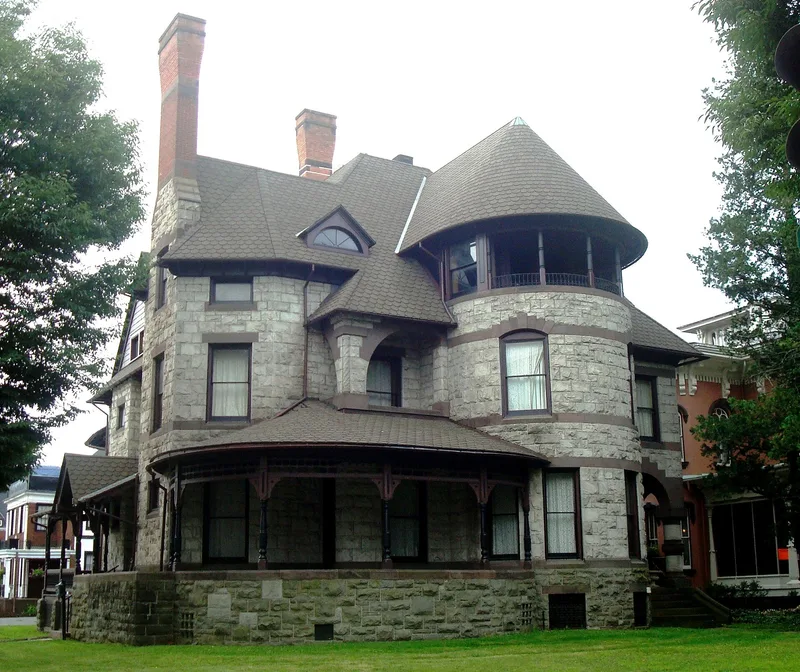

Why it's listed
Most of the buildings in this residential district in central Williamsport are Victorian-era houses, built mainly between 1860 and 1920 during the city's lumber boom. The district holds 289 buildings, of which 102 are classed as significant. Williamsport's growth came after the 1847 establishment of a log boom on the Susquehanna River, which drew sawmills, railroads and timber wealth to the city. Lumber figures rose sharply, from 196,953 logs in 1862 to 1,816,562 in 1891. Eber Culver designed many of the larger homes, and builder Peter Herdic constructed several of them, including an 1855 Italianate house at 407 West Fourth Street. The district's houses range from Second Empire mansions to Queen Anne, Eastlake and Romanesque examples. The area was subdivided into apartments after the 1936 flood and the 1940s growth of a nearby technical institute.
Significance in brief: The nomination argues the district represents the peak of Williamsport's social, economic and cultural history, built during the prosperous lumber era. Its concentration of elaborate mansions reflects the wealth of the lumber barons who built them. Architect Eber Culver and builder Peter Herdic are credited with many of the most imposing Second Empire homes, and the district contains a wide range of Victorian styles.
Machine-generated summary. This summary was generated by a language model from the official nomination document and has not been reviewed line by line by an editor. It may contain errors. Check the source document before relying on any detail. Source: nomination document (PDF) · National Archives catalog entry. NRHP reference 85000120, listed January 24, 1985. Summary generated October 2026 (model claude-haiku-5-5, prompt v1.1-2026-10-29, confidence medium).
Key facts
| Address | Roughly bounded by Nichols Pl., Elmira and W. 3rd Sts., and 7th Ave., Williamsport |
|---|---|
| County | Lycoming County |
| Listed | January 24, 1985 |
| Reference number | 85000120 |
| Resource type | District |
| Period of significance | 1855-1920 |
| Architect / builder | Eber Culver (architect); Peter Herdic (builder) |
| Architectural style | Victorian (Second Empire, Queen Anne, Eastlake, Italianate, Victorian Gothic, Romanesque, Colonial Revival, Neo-Classical) |
| Criteria |
|
| Areas of significance | Industry, Architecture |
| Level of significance | Local |
| Status (as stated in the nomination) | The district is described as deteriorating in general condition, with many large houses subdivided into multi-family rental units. |
| Acreage | 100 |
| Coordinates | 41.23903, -77.01803 (NPS GIS) |
What listing means for this property
This is a historic district. Buildings within its boundary are either contributing (they add to the district's significance) or non-contributing. Owners of contributing income-producing buildings can claim the 20% federal rehabilitation tax credit; homeowners should look at state credits. National Register districts impose no design review by themselves; a local historic district ordinance, if one exists, does (the difference explained).
General information, not legal or tax advice. Rules change; confirm with your State Historic Preservation Office or a qualified adviser.
Sources and further reading
- National Park Service, National Register of Historic Places database (snapshot May 2026), reference 85000120.
- Nomination form (PDF, National Archives) — catalog entry
- Wikipedia article (used for cross-checking only; text not reproduced here)
- Wikidata Q15253418
- This listing as JSON
Last updated October 2026. Found an error? See the editorial policy for how to report it.