Donegal Mills Plantation

Why it's listed
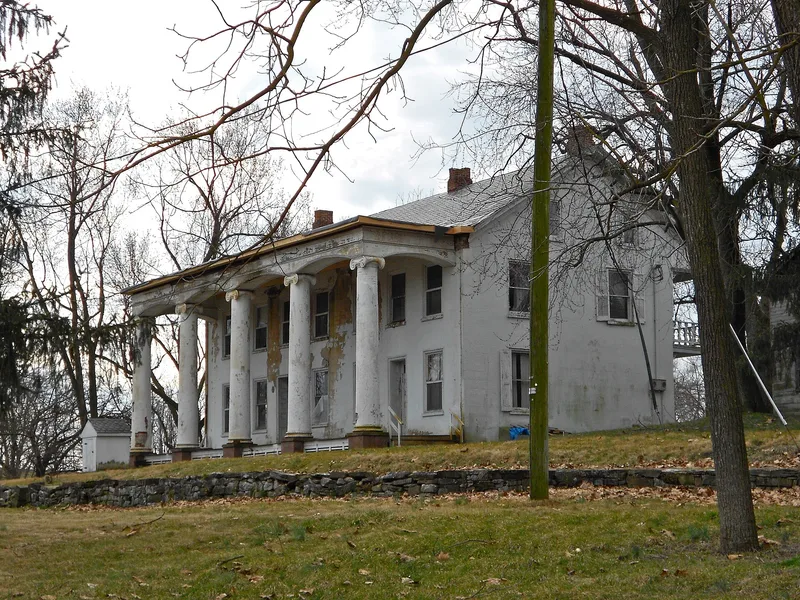
Donegal Mills Plantation occupies a valley along Donegal Creek south of Mount Joy, Lancaster County, and includes a stone grist mill begun by Abraham Stouffer between 1775 and 1779, a mansion house originally built around 1790, a miller's house, and a bake house. Stouffer's mill was run by an interior overshot wheel until it was converted to steam power in the 1870s, and it was deactivated in 1925. Jacob Kraybill, who owned the property for roughly 86 years, expanded the mansion around 1810 and 1830. The 1830s remodeling added a northern wing, a central hall, a two-story front porch with brick columns and a stucco finish, including a monumental Ionic portico. The site is regarded as a rare survivor of an early rural milling community, with many unchanged buildings from before 1830. Its mansion is cited as one of the few large Greek Revival houses in the region. Kraybill family wills also funded the Kraybill Mennonite Church, graveyard and school.
Significance in brief: The nomination argues the site is one of very few rural water-powered grist mill sites of the late 18th century that retains many early buildings, pre-1830, and has not been encroached upon by suburban development. It also argues the mansion's 1830s stone and stucco remodeling with an Ionic portico is a rare example of large-scale Greek Revival domestic architecture in Lancaster County and Southeastern Pennsylvania.
Machine-generated summary. This summary was generated by a language model from the official nomination document and has not been reviewed line by line by an editor. It may contain errors. Check the source document before relying on any detail. Source: nomination document (PDF) · National Archives catalog entry. NRHP reference 78002418, listed January 20, 1978. Summary generated October 2026 (model claude-haiku-5-5, prompt v1.1-2026-10-29, confidence medium).
Key facts
| Address | SW on Mount Joy on Trout Run Rd., Mount Joy |
|---|---|
| County | Lancaster County |
| Listed | January 20, 1978 |
| Reference number | 78002418 |
| Resource type | Building |
| Period of significance | c. 1775-1830 |
| Architectural style | Greek Revival |
| Criteria |
|
| Areas of significance | Industry, Architecture |
| Level of significance | State |
| Status (as stated in the nomination) | Opened to the public on July 4, 1974 as the Donegal Mills Plantation after restoration by the Zink family. |
| Acreage | 3.5 |
| Coordinates | 40.08520, -76.54020 (NPS GIS) |
What listing means for this property
National Register listing is honorary for a privately owned home: it does not by itself restrict what an owner may do with their own money, and it does not require public access. Restrictions come from local landmark or historic-district ordinances, which are separate (how they differ).
Owner-occupied houses are not eligible for the 20% federal rehabilitation tax credit, which applies to income-producing buildings, but many states offer credits for homeowners. Listing also opens the door to preservation easements and to buying a plaque. Start with what listing means for homeowners, renovating a listed house and selling one.
General information, not legal or tax advice. Rules change; confirm with your State Historic Preservation Office or a qualified adviser.
Sources and further reading
- National Park Service, National Register of Historic Places database (snapshot May 2026), reference 78002418.
- Nomination form (PDF, National Archives) — catalog entry
- Wikipedia article (used for cross-checking only; text not reproduced here)
- Wikidata Q5295613
- This listing as JSON
Last updated October 2026. Found an error? See the editorial policy for how to report it.