Powderly, Terence V., House

Why it's listed
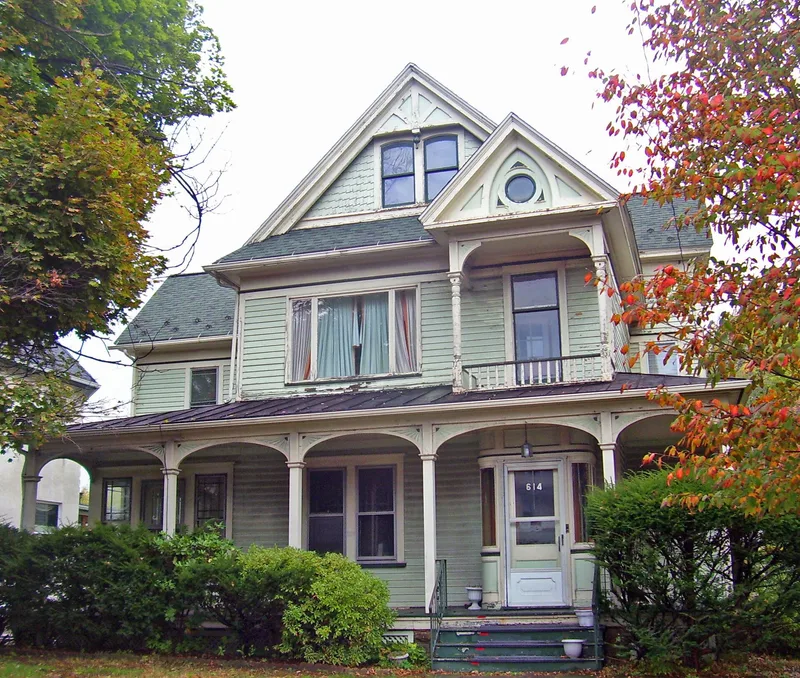
A two-story clapboard house at 614 North Main Street in Scranton, Pennsylvania, is the former home of Terence Vincent Powderly, who lived there for many years. Painted olive-green, it has a cross-gabled roof, a front porch that once extended along both sides of the house, and an unusual glass ante-entrance over the front door. The ground floor retains its original layout, including a long living room with a high ceiling and a small parlor with a fireplace, and the woodwork is dark throughout. The kitchen has been modernized and the second floor converted to an apartment. Powderly was born in Carbondale in 1849, worked as a machinist, and rose to lead the Knights of Labor from 1879 until 1893. He championed arbitration over strikes, and his leadership is regarded as central to the labor movement of the 1880s. The house is significant for its association with his life and career.
Significance in brief: The nomination argues that Powderly dominated the American labor movement in the 1880s as Grand Master Workman of the Knights of Labor, and that his advocacy of arbitration shaped the union's approach. The house is significant as the place where he lived for many years, and the text notes it is little changed.
Machine-generated summary. This summary was generated by a language model from the official nomination document and has not been reviewed line by line by an editor. It may contain errors. Check the source document before relying on any detail. Source: nomination document (PDF) · National Archives catalog entry. NRHP reference 66000667, listed October 15, 1966. Summary generated October 2026 (model claude-haiku-5-5, prompt v1.1-2026-10-29, confidence high).
Key facts
| Address | 614 N. Main St., Scranton |
|---|---|
| County | Lackawanna County |
| Listed | October 15, 1966 |
| Reference number | 66000667 |
| Resource type | Building |
| Period of significance | 1849-1924 |
| Areas of significance | Social History |
| Level of significance | National |
| National Historic Landmark | Yes, designated May 23, 1966 |
| Status (as stated in the nomination) | Maintained as a private residence; the second floor has been converted into an apartment. |
| Acreage | 0.9 |
| Coordinates | 41.41838, -75.67457 (NPS GIS) |
What listing means for this property
National Register listing is honorary for a privately owned home: it does not by itself restrict what an owner may do with their own money, and it does not require public access. Restrictions come from local landmark or historic-district ordinances, which are separate (how they differ).
Owner-occupied houses are not eligible for the 20% federal rehabilitation tax credit, which applies to income-producing buildings, but many states offer credits for homeowners. Listing also opens the door to preservation easements and to buying a plaque. Start with what listing means for homeowners, renovating a listed house and selling one.
General information, not legal or tax advice. Rules change; confirm with your State Historic Preservation Office or a qualified adviser.
Sources and further reading
- National Park Service, National Register of Historic Places database (snapshot May 2026), reference 66000667.
- Nomination form (PDF, National Archives) — catalog entry
- Wikipedia article (used for cross-checking only; text not reproduced here)
- Wikidata Q7702021
- This listing as JSON
Last updated October 2026. Found an error? See the editorial policy for how to report it.